

Spread betting platforms in the UK differ in pricing, speed, and platform features, which can make choosing one feel confusing.
This guide compares the leading FCA-regulated providers side by side, focusing on spreads, tools, and overall usability.
Everything is explained in plain English so you can quickly see which platform fits your trading style and risk level.
Key takeaway: What’s the best spread betting platform in the UK?
The best spread betting platform in the UK is IG, offering the widest market range, powerful tools and trusted FCA regulation. Pepperstone follows closely behind, delivering the lowest spreads and fast execution for MT4, MT5 and TradingView traders.
Best spread betting platforms compared
| Broker | Spreads | Platform supported | Market range | Best for |
|---|---|---|---|---|
| IG | ★★★★☆ (Strong across most asset classes) | IG Platform, MT4, ProRealTime | 17,000+ markets | All-round choice, professional tools, global access |
| Pepperstone | ★★★★★ (Lowest spreads, especially FX) | MT4, MT5, cTrader, TradingView | ~1,200+ markets | Low-cost trading, algorithmic traders, forex specialists |
| Spreadex | ★★★★☆ (Tight across indices & shares) | Proprietary Web, TradingView | 10,000+ markets incl. AIM & small caps | UK shares, share traders, simple low-cost setup |
| Capital.com | ★★★☆☆ (Good but not the lowest) | Web, Mobile, MT4, TradingView | ~2,500 markets | Beginners, mobile traders, AI-assisted insights |
| CMC Markets | ★★★★☆ (Competitive, especially indices) | Next Generation, MT4 | 12,000+ markets | Active traders, technical analysis, large market access |
Top 5 spread betting brokers UK – best for list
- IG – Best all-round spread betting platform with the widest market range
- Pepperstone – Best for low spreads and MT4/MT5 traders
- Spreadex – Best for UK shares and simple low-cost trading
- Capital.com – Best for beginners and mobile-first trading with AI insights
- CMC Markets – Best for active traders and advanced charting
UK spread betting platform reviews
UK spread betting platforms differ in market coverage, pricing, and trading tools, so the reviews below focus on regulation, platform quality, and suitability for UK traders.
1. IG – Best for range of markets and professional-grade tools

Should you use IG as a spread betting platform?
Yes. IG is an excellent choice if you want the widest market coverage, consistently tight spreads, and strong platform flexibility.
Its combination of FCA regulation, fast execution, and powerful charting tools makes it one of the safest and most advanced spread betting platforms in the UK.
Traders who value research depth, reliable execution, and access to over 17,000 markets will find IG hard to beat, although complete beginners may prefer a simpler platform with fewer choices.
Key info – IG spread betting
| Feature | Details |
|---|---|
| FCA Authorised | Yes |
| Total Markets | 17,000+ (industry-leading) |
| Average EUR/USD Spread | 0.85 pips |
| Platforms | IG Platform, MetaTrader 4, ProRealTime |
| Minimum Deposit | £0 (bank transfer) |
| Execution | Very fast, no-dealing-desk style |
| Education | IG Academy, daily market analysis |
| Risk Warning | 67% of retail accounts lose money |
How competitive are IG’s spreads and trading costs?
IG offers tight, consistently low spreads, including 0.85 pips on EUR/USD and highly competitive pricing across indices, forex, and commodities. Costs are built into the spread, with no commissions for spread betting. Overnight financing applies to leveraged positions. IG ranked among the lowest-cost brokers in our tests despite its huge market range.
How strong is IG’s trading experience and execution speed?
IG delivers fast, reliable execution with minimal slippage, supported by strong liquidity and alternative pricing venues. The proprietary platform is intuitive for most traders, while MT4 and ProRealTime offer advanced charting, automation, and technical tools. IG’s platform depth puts it among the most professional-grade options for UK spread betting.
Does IG offer a wide enough range of markets to trade?
Yes. IG provides the largest market range in the industry, with 17,000+ instruments, including 80+ forex pairs, 130+ indices, 12,000+ shares, 6,000+ ETFs, commodities, bonds, and 7,000+ options markets. IG is the only UK trading platform offering spread betting on options and has excellent futures markets for longer-term, overnight-fee-free strategies.
What tools, research, and education does IG provide?
IG offers one of the strongest research suites on the market. Traders get Signal Centre alerts (Autochartist + PIA First), IG TV, economic calendars, market commentary, and comprehensive charting. The IG Academy provides structured courses and webinars, making IG suitable for both beginners and advanced technical traders.
Who is IG best for?
IG is best for traders who want the biggest market range, strong execution, and advanced charting tools. It suits experienced traders, active day traders, and anyone who values deep research and platform flexibility. Beginners can also benefit, although the large menu of markets may feel overwhelming at first.
Read the complete IG review here.
Pros & cons
Pros
- Largest market selection in the UK (17,000+)
- Tight spreads from 0.85 pips
- Excellent proprietary, ProRealTime, and MT4 platforms
- Strong FCA-regulated safety and FTSE 250 transparency
- High-quality signals, research, and education
Cons
- MT4 cannot access full market range
- No TradingView integration
- Customer service response times can vary
- Overnight financing fees on leveraged positions
2. Pepperstone – Best for low-cost forex spread betting and fast execution

Should you use Pepperstone as a spread betting platform?
Yes. Pepperstone is one of the best choices for UK spread bettors who prioritise tight spreads, fast execution, and professional-grade platforms. With spreads from 0.60 pips, sub-100ms execution, and FCA regulation, it offers exceptional value for active forex and index traders. The main trade-offs are a smaller market range than IG and no guaranteed stop-losses.
Key info – Pepperstone spread betting
| Feature | Details |
|---|---|
| FCA Authorised | Yes |
| Markets | 1,200+ |
| Average EUR/USD Spread | 0.60 pips |
| Platforms | MT4, MT5, cTrader, TradingView |
| Execution Speed | ~77ms limit orders |
| Minimum Deposit | £0 |
| Account Types | Standard & Razor |
| Risk Warning | 72% of retail accounts lose money |
Is Pepperstone properly FCA regulated and safe to use?
Yes. Pepperstone is FCA authorised, segregates client funds, and provides negative balance protection for retail traders. Supported by multiple tier-1 regulators including ASIC and BaFin, it maintains high standards for transparency and client safeguarding. With 400,000+ clients and £12bn daily trading volume, it scores highly for trust.
How competitive are Pepperstone’s spreads and trading costs?
Pepperstone offers the lowest spreads of any UK spread betting broker we tested. EUR/USD averages 0.60 pips, with competitive pricing across all major pairs.
Razor accounts offer raw spreads from 0.0 pips plus commission, while Standard accounts fold costs into the spread.There are no deposit, withdrawal, or inactivity fees, and overnight funding is standard.
How strong is Pepperstone’s trading experience and execution speed?
Pepperstone provides some of the fastest execution speeds in the UK market, with ~77ms limit orders and ~100ms market orders. Its no-dealing-desk model routes trades directly to liquidity providers, improving fill quality and reducing slippage. This setup makes Pepperstone ideal for scalpers, day traders, and algorithmic strategies.
Does Pepperstone offer a wide enough range of markets to trade?
Pepperstone offers 1,200+ markets, covering forex, indices, commodities, ETFs, metals, and over 1,000 shares. The range is more than sufficient for most traders, though smaller than IG’s 17,000+ markets. Pepperstone stands out most in forex (93 pairs), metal crosses, and volatility indices rather than niche equities or options.
What tools, research, and education does Pepperstone provide?
Pepperstone delivers excellent tools for active and automated traders, including Smart Trader Tools for MT4/MT5, Autochartist, and Capitalise.ai for no-code automation. Education includes weekly webinars, The Trade Off show, Navigating Markets reports, and 100+ trading guides, providing strong support for both beginner and advanced traders.
Who is Pepperstone best for?
Pepperstone is best for forex traders, scalpers, algorithmic traders, and day traders who want low costs and fast execution. It suits anyone who prefers MT4, MT5, cTrader, or TradingView. Traders who want a large market range, guaranteed stop-losses, or a beginner-focused proprietary platform may prefer IG or CMC Markets.
Read the complete Pepperstone review here.
Pros & cons
Pros
- Lowest spreads from 0.60 pips
- Fastest execution speeds tested
- MT4, MT5, cTrader, TradingView support
- No minimum deposit or inactivity fee
- Excellent automation tools and add-ons
Cons
- No guaranteed stop-loss orders
- Market range smaller than IG or CMC
- Demo account expires after 30 days
- Limited e-wallet options
3. Spreadex – Best for niche markets, small-cap shares, and TradingView charting

Should you use Spreadex as a spread betting platform?
Yes. Spreadex is an excellent choice if you want tight spreads, a huge range of 10,000+ markets, and access to TradingView alongside its own proprietary platform.
It suits UK traders who want low-cost spread betting, small-cap share coverage, and FCA protection. The main drawbacks are no demo trading account and fewer advanced trading tools than MT4/MT5 brokers.
Key info – Spreadex spread betting
| Feature | Details |
|---|---|
| FCA Authorised | Yes |
| Markets Available | 10,000+ |
| Average EUR/USD Spread | 0.90 pips |
| Platforms | Spreadex Web, TradingView |
| Execution Model | Market Maker with best-execution improvements |
| Minimum Deposit | £1 |
| Funding Fees | £0 for UK debit, no withdrawal fees |
| Risk Warning | 65% of retail accounts lose money |
Is Spreadex properly FCA regulated and safe to use?
Yes. Spreadex is fully FCA regulated and has been operating since 1999, with a strong safety record and segregated client funds. As an FCA firm, traders receive FSCS protection up to £85,000 and strict oversight of trading practices. Spreadex also holds a UK Gambling Commission licence for sports spread betting, reinforcing its UK regulatory footprint.
How competitive are Spreadex’s spreads and trading costs?
Spreadex has some of the lowest spreads in the UK, ranking second only to Pepperstone in recent tests. EUR/USD averages 0.90 pips, EUR/GBP 1.20 pips, and AUD/USD 1.10 pips. There are no deposit fees, no withdrawal fees, and no inactivity charges, making Spreadex extremely cost-efficient. Financing follows SONIA or SOFR benchmarks, and futures contracts incur no overnight funding.
How strong is Spreadex’s trading experience and execution speed?
Execution is consistently reliable thanks to Spreadex’s market-maker model with price improvement. During testing, orders filled quickly with minimal slippage, and the platform’s best-execution policy often improves poor quotes. The proprietary web platform now supports one-click dealing, layout customisation, and automated trendlines, making it far smoother than earlier versions.
Does Spreadex offer a wide enough range of markets to trade?
Yes. Spreadex offers one of the largest market selections in the UK, with 10,000+ instruments including shares, indices, commodities, forex, ETFs, options, bonds, interest rates, and even sports spread betting. Small-cap AIM stocks, IPOs, political markets, and bespoke equities can also be requested, something few UK competitors allow.
What tools, research, and education does Spreadex provide?
Spreadex provides strong in-house market analysis, daily updates, weekly technical views, and a structured 35-lesson education hub. TradingView integration adds 100+ indicators and advanced charting, while the Spreadex platform offers pattern recognition and pro trendlines. However, there is no demo account and educational content is text-heavy without video modules.
Who is Spreadex best for?
Spreadex is best for traders who want huge market variety, access to small-cap shares and futures, and the flexibility of TradingView. It suits active traders, share specialists, and those who value UK-focused service and FCA safety. Beginners may prefer more educational support, and algorithmic traders may prefer MT4/MT5 brokers.
Read the complete Spreadex review here.
Pros & cons
Pros
- 10,000+ financial markets plus sports spread betting
- Tight spreads and no deposit, withdrawal, or inactivity fees
- TradingView integration with advanced charting
- Excellent UK-based customer service (24/5 live chat)
- Customisable web platform with strong charting add-ons
Cons
- No demo account
- No MetaTrader platform (MT4/MT5)
- Education useful but limited vs larger brokers
- Guaranteed stops only on major markets
4. Capital.com – Best for low-cost spread betting and multiple trading platforms
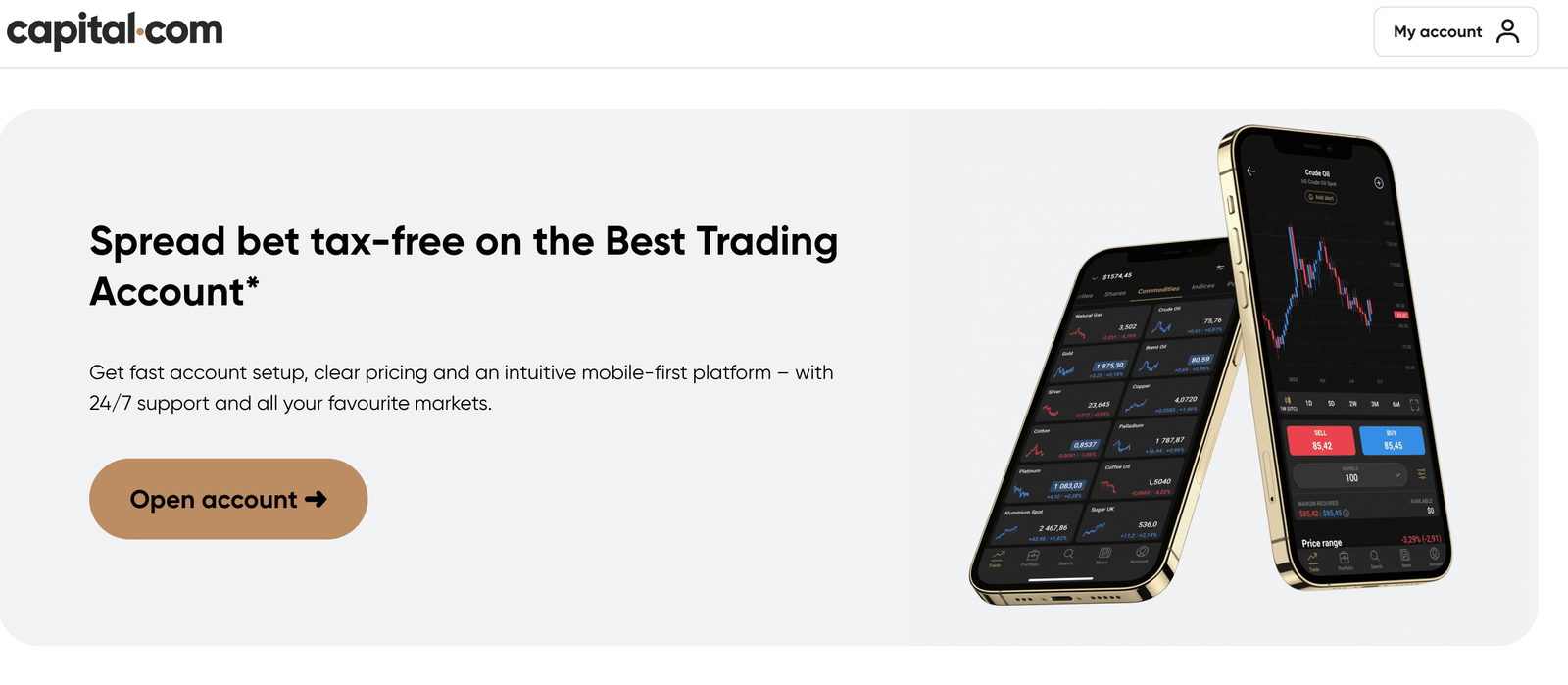
Should you use Capital.com as a spread betting platform?
Yes. Capital.com is a strong choice if you want tight spreads, an intuitive platform, and access to MT4 and TradingView, which is rare among UK spread betting brokers. It offers over 2,500 markets and 120+ FX pairs, making it suitable for multi-asset traders. The main drawbacks are patchy customer support reports and occasional execution issues highlighted in user feedback.
Key info – Capital.com spread betting
| Feature | Details |
|---|---|
| FCA Authorised | Yes |
| Markets Available | 2,500+ |
| FX Pairs | 120+ |
| Average EUR/USD Spread | 0.60 pips |
| Platforms | MT4, TradingView, Capital.com Web/App |
| Minimum Deposit | £20 (£50 via bank transfer) |
| Extra Fees | None (no deposit, withdrawal, or inactivity fees) |
| Risk Warning | 64% of retail accounts lose money |
Is Capital.com properly FCA regulated and safe to use?
Yes. Capital.com is FCA regulated and also authorised by CySEC and ASIC, giving it a strong multi-regulator safety profile. Client funds are held in segregated accounts and retail traders receive negative balance protection. With over 500,000 traders and 4.6/5 on Trustpilot, it maintains a solid reputation for trust and transparency.
How competitive are Capital.com’s spreads and trading costs?
Capital.com offers spread-only pricing with no commissions on spread bets. EUR/USD averages 0.6 pips, in line with Pepperstone and tighter than the industry average of 1.0 pip. Index spreads are competitive (FTSE 100 around 1 point), while share spreads can be higher than average on UK and EU stocks. There are no deposit, withdrawal, or inactivity fees, making it a cost-effective option.
How strong is Capital.com’s trading experience and execution speed?
Execution is fast and stable for most traders, with an average execution time of 0.032 seconds. The proprietary platform is intuitive, offers 75+ indicators, and supports monetary-based stop losses. MT4 enables automated trading via Expert Advisors, while TradingView offers best-in-class charting. Some traders have reported order rejections or weaker support responsiveness, which aligns with mixed user reviews.
Does Capital.com offer a wide enough range of markets to trade?
Yes. Capital.com offers 2,500+ markets, including 120 forex pairs, 50+ commodities, 32 indices, and thousands of equities. You can also spread bet UK and US stocks in GBP, avoiding FX conversion fees. The product range is slightly above industry average but not as extensive as IG or Spreadex.
What tools, research, and education does Capital.com provide?
Capital.com offers strong educational tools, including the Investmate learning app, in-platform lessons, risk alerts, and AI insights that flag potential behavioural mistakes. Research includes in-house market analysis, news updates, and Refinitiv reports on US equities. However, education can feel text-heavy, and tools are less advanced than premium MT4 add-ons or CMC/IG research suites.
Who is Capital.com best for?
Capital.com is best for beginners, mobile traders, and technical traders who want MT4 or TradingView. It suits those seeking low spreads, simple pricing, and strong educational support. High-frequency or precision-focused traders may prefer Pepperstone, while those wanting thousands of markets may prefer IG or Spreadex.
Read the complete Capital.com review here.
Pros & cons
Pros
- Tight spreads from 0.6 pips
- MT4 and TradingView support
- 120+ forex pairs and 2,500+ markets
- No deposit, withdrawal, or inactivity fees
- Excellent mobile trading app and AI-driven behavioural coaching
Cons
- No MT5 or cTrader
- Some traders report execution and support issues
- Education materials could be more engaging
- Share spreads higher than industry average on some markets
5. CMC Markets – Best for active traders and advanced charting

Should you use CMC Markets as a spread betting platform?
Yes. CMC Markets is one of the strongest spread betting platforms in the UK for serious traders. It combines consistently tight spreads, innovative tools like pattern recognition and client sentiment filters, and a highly polished platform that performs well on desktop and mobile.
Key info – CMC Markets spread betting
| Feature | Details |
|---|---|
| Regulation | FCA (UK) |
| Minimum Deposit | £0 |
| Markets Available | 12,000+ |
| Forex Pairs | 330+ |
| Platforms | Next Generation (NGEN), Mobile App |
| Typical EUR/USD Spread | From ~0.8 pips |
| Guaranteed Stops | Yes |
| Retail Risk Warning | 67% of retail accounts lose money |
Is CMC Markets properly FCA regulated and safe to use?
Yes. CMC Markets is FCA authorised and regulated, with client funds held in segregated accounts. It provides negative balance protection for retail clients and follows strict UK regulatory standards. As a long-established UK broker, it has a strong reputation for transparency and financial stability.
How competitive are CMC Markets’s spreads and trading costs?
CMC Markets offers very competitive spreads, especially on major indices and forex. Examples include EUR/USD from around 0.8 pips and major indices from roughly 0.7 points. There are no commissions on spread betting, though standard overnight financing applies to leveraged positions.
How strong is CMC Markets’s trading experience and execution speed?
The trading experience is excellent. CMC’s Next Generation (NGEN) platform delivers fast execution, high stability, and advanced order types including guaranteed stop-loss orders. Over 70% of trades are placed on mobile, highlighting the platform’s strong performance and usability across devices.
Does CMC Markets offer a wide enough range of markets to trade?
Yes. CMC Markets offers 12,000+ markets, including an industry-leading 330+ forex pairs, indices, commodities, shares, and themed share baskets. While it focuses mainly on major markets, the overall depth easily supports most active trading strategies.
What tools, research, and education does CMC Markets provide?
CMC Markets excels here. It offers 80+ technical indicators, pattern recognition tools, advanced charting, filtered client sentiment, and sector share baskets. Research includes daily market analysis, webinars, platform guides, and educational content suitable for both intermediate and advanced traders.
Who is CMC Markets best for?
CMC Markets is best for experienced and active traders who value tight spreads, sophisticated analysis tools, and deep market access. It may feel complex for beginners, but for technical traders and frequent spread bettors, it’s one of the most powerful FCA-regulated options in the UK.
Read the complete CMC Markets review here.
Pros and cons
Pros
- Extremely tight spreads on forex and indices
- Advanced charting and pattern recognition
- Large market range including share baskets
- Fully FCA regulated with strong UK reputation
Cons
- Platform complexity for beginners
- Limited access to smaller niche markets
- No MT4 spread betting or automation tools
What is spread betting and how does it work?
Spread betting means you are guessing whether a market like a share price, an index, or a currency will go up or down. You choose how much money to risk per point of price movement, such as £1 or £5 per point, rather than buying the asset itself.
You never own the share, currency, or commodity. Your profit or loss is worked out by how many points the price moves and your stake per point. If the market moves in your favour, you win. If it moves against you, you lose.
The spread betting company makes money by charging a spread, which is the small gap between the buy price and the sell price. If you keep a trade open overnight, you may also pay a financing fee.
What is a spread betting broker (vs a forex broker)?
A spread betting broker is a company that lets you place spread bets on markets like shares, indices, currencies, and commodities. Instead of buying the asset, you are betting on whether the price will go up or down, usually using leverage, which means you only put down a small deposit.
A forex broker mainly focuses on trading currency pairs, often using CFDs or spot forex. In the UK, many brokers offer both forex trading and spread betting, but only firms regulated in the UK or Ireland are allowed to offer financial spread betting.
How does spread betting compare to buying stocks or forex, or to CFD trading?
- Buying shares or ETFs: You own the asset and usually invest without leverage. Profits may be subject to Capital Gains Tax, and UK shares can also have stamp duty.
- CFDs: You do not own the asset but trade on margin and can go long or short. Profits are generally subject to Capital Gains Tax in the UK.
- Spread betting: You do not own the asset and can trade with leverage in both directions. Profits are currently free from UK Capital Gains Tax and stamp duty, but the risk is higher than buying investments outright.
What is forex spread betting?
Forex spread betting is just spread betting on currency pairs (e.g. GBP/USD, EUR/JPY).
You stake an amount per pip or point of movement and can trade majors, minors and exotics, often 24 hours a day during the week.
What is spread betting leverage and what’s available in the UK?
Leverage means you only deposit a small amount, called margin, while your profit or loss is based on the full trade size.
Under FCA rules for UK retail traders, leverage is capped at 30:1 for major FX, 20:1 for minor FX and major indices, 10:1 for most commodities, and 5:1 for shares and many ETFs, but losses can still add up quickly.
Is spread betting tax-free in the UK?
At the time of writing, profits from financial spread betting are generally exempt from UK capital gains tax and stamp duty, because it’s classified as gambling rather than investing.
Tax treatment can change and depends on your personal circumstances, so it’s sensible to confirm details with a qualified tax adviser.
What are the pros and cons of spread betting (and is it right for you?)
Pros:
- Tax-efficient for many UK residents (no CGT or stamp duty on profits).
- Go long or short easily, with access to many global markets from one account.
- Use leverage to control larger positions with smaller initial capital.
Cons:
- High risk: losses can exceed your initial deposit if you don’t manage risk carefully (though retail spread betting accounts have negative balance protection).
- Financing costs on overnight positions can add up.
- It’s easy to over-trade or over-leverage, especially for beginners.
Spread betting is usually more suitable for short-term, active traders who understand leverage and risk, rather than for hands-off long-term investors.
How can you manage risk with spread betting?
- Risk a small, fixed percentage of your capital per trade (many active traders stay within 0.5–2%).
- Use stop-loss orders, and consider guaranteed stops where available to avoid gap risk.
- Keep leverage conservative, avoid holding large positions over major news unless you fully understand the risk, and diversify across markets rather than betting everything on one idea.
- Regularly review drawdowns and be willing to scale back if performance deteriorates.
How to choose a spread betting broker UK
- Regulation & safety: FCA authorisation, segregated client money, clear risk warnings and complaints processes.
- Costs: Tight, transparent spreads, no or low extra fees (funding, withdrawals, inactivity), and competitive overnight financing. Pepperstone is known for ultra-tight forex spreads, CMC Markets keeps index spreads consistently low, and IG offers predictable pricing with few hidden fees.
- Platforms & tools: Stable web/mobile platforms, good charting, fast execution, and any specialist tools you need (e.g. MT4/MT5, TradingView, advanced order types). IG’s proprietary platform and CMC’s Next Generation suit active traders, while Pepperstone supports MT4, MT5 and TradingView for algorithmic and technical strategies
- Markets: Enough instruments for your strategy (FX, indices, shares, commodities, ETFs, options, etc.).IG and CMC Markets lead for breadth, covering FX, indices, shares, commodities, ETFs and options, while Pepperstone focuses more on forex and major indices with professional-grade pricing.
- Support & education: Responsive customer service plus genuinely useful education and market research. IG and CMC Markets stand out for research, webinars and market analysis, while Pepperstone offers solid support and platform-focused education for active traders.
Should you use a spread betting broker?
A spread betting broker can be a powerful tool if you:
- Want to trade actively, short-term.
- Value the ability to go long/short with leverage.
- Are comfortable with the high risk and have a clear risk management plan.
How we test spread betting platforms in the UK
UK spread betting platforms are assessed using a structured review process that scores each provider on FCA regulation, spreads and pricing, platform usability, charting and risk management tools, order execution, and customer support.
Each category is rated from 1 to 5 using live account testing, real spread bets, and verification of all core platform features. Reviews prioritise FCA authorisation, pricing transparency, platform stability, and suitability for UK retail traders.
Scoring is based on hands on testing of desktop and mobile platforms, comparison of spreads across major markets, evaluation of stop loss and guaranteed stop features, and checks on funding speed, margin requirements, and available markets.
This approach ensures every recommendation is independent, evidence based, and reflects real world spread betting performance rather than marketing claims.
For a full breakdown of our methodology, see our detailed guide on How We Test.
FAQs
Which platform has the best spreads?
Pepperstone typically offers the lowest spreads, especially on major forex pairs, followed by Spreadex and Capital.com.
Is spread betting gambling in the UK?
For tax purposes, yes, profits are treated like gambling winnings (tax-free). For regulation, no, spread betting is overseen by the FCA like other financial products.
Is spread betting legal in the UK?
Yes. It is fully legal and regulated by the Financial Conduct Authority (FCA).
Is spread betting tax-free?
Yes. UK residents pay no capital gains tax or stamp duty on profits. (Tax rules may change.)
Can beginners use spread betting platforms?
Yes, but spread betting is high risk. Start with a demo account and small position sizes.
Spread betting vs CFD trading, what’s the difference?
Spread betting and CFD trading both let you trade price movements using leverage, but they differ mainly in tax treatment. In the UK, spread betting profits are usually tax free, while CFD profits are taxable. Both are FCA regulated and carry a high risk of losses.
Can you lose more than your deposit?
No. FCA-regulated spread betting companies provide Negative Balance Protection
Which spread betting platform is best for MT4/MT5?
Pepperstone, fastest execution and widest platform choice (MT4, MT5, cTrader, TradingView).
How to avoid spread betting tax in the UK?
In most cases there is no UK tax to “avoid” because HMRC generally treats financial spread betting profits as gambling winnings for individuals, so they are typically not subject to Capital Gains Tax. The trade off is that losses are not normally tax deductible, and tax treatment can differ for companies or unusual circumstances, so a tax adviser is sensible if spread betting is being done through a business.
How do you trade tax-free with spread betting?
You trade tax free by using an FCA regulated spread betting account, since profits are usually exempt from CGT and stamp duty for most UK residents. This is a tax position rather than a strategy, and HMRC treatment can depend on personal circumstances and can change over time.
What is better, CFD or spread betting?
Spread betting is often better for UK residents who want tax efficiency because profits are usually tax free, while CFD profits are generally taxable. CFDs can be preferable if you want to offset losses against gains for tax purposes, or if spread betting is not available in your jurisdiction.
What is the best spread betting platform UK for beginners?
The best spread betting platform for beginners is Capital.com. It is usually the easiest starting point because it has a low minimum deposit and a simple, mobile first platform, while still being FCA regulated. IG is the strongest all round platform, but its huge market range and tool depth can feel like a lot on day one.
Are spread betting brokers safe?
They can be safe when they are FCA regulated, segregate client money, and provide negative balance protection for retail clients, which limits losses to the funds in the account. Safety of the broker does not remove product risk, as spread betting is leveraged and most retail clients lose money.
What are the best spread betting apps?
The best spread betting apps in the UK combine FCA regulation, tight spreads, and easy-to-use mobile platforms. Top options are IG for the widest market range and professional tools, Pepperstone for the lowest spreads and fast execution, Capital.com for beginners and mobile first trading, CMC Markets for advanced charting, and Spreadex for UK shares and niche markets.
References
- https://www.gov.uk/hmrc-internal-manuals/capital-gains-manual/cg56105
- https://www.lse.ac.uk/accounting/assets/CARR/documents/R-R/2013-Winter/CARRmagRR26-Loussouarn.pdf
- https://metsearch.cardiffmet.ac.uk/discovery/fulldisplay/alma99258525202425/44WHELF_CMU:44WHELF_CMU_NUI1
- https://resolve.cambridge.org/core/journals/behavioural-public-policy/article/trading-is-a-losing-game-an-audit-of-deceptive-choice-architecture-in-demomode-contract-for-difference-cfd-trading-apps/07BB4E4CC011413D8A41458F9ED32928