

Finding the best options trading platforms in the UK depends on fees, regulation, platform tools, and who the service is designed for.
This guide compares FCA-regulated and UK-available options brokers in 2026, focusing on costs, features, and suitability for different trader types.
Quick verdict: Which is the best options trading platform in the UK?
Interactive Brokers is the best overall choice due to its low fees, global listed options access, and professional-grade tools. IG is the strongest UK-based alternative, while other platforms suit specific trader needs. The best options trading platform in the UK depends on your experience level and whether you want listed options or options-style trading.
Top 5 UK options trading platforms
- Interactive Brokers – Best for: Experienced and professional traders who want the lowest fees, global options access, and advanced trading tools.
- IG – Best for: Advanced UK traders looking for a strong all-round platform with listed options, spread betting, and powerful analytics.
- CMC Markets – Best for: Technical and strategy-driven traders who prioritise execution quality, charting, and professional-grade platforms.
- Spreadex – Best for: UK traders focused on tax-free spread betting, fast execution, and simple, reliable platforms.
- Capital.com – Best for: Beginners and mobile-first traders who want low fees, a clean interface, and strong built-in education.
Top UK options & derivatives platforms comparison
| Platform | Options access | Fees & pricing | Platform usability | Best for |
|---|---|---|---|---|
| IG | Listed US options, index options, options on futures | $1 per contract to open, $0 to close on US equity options, plus exchange fees | Powerful but complex. Best once you learn the platform | Advanced UK traders wanting broad markets and strong options analytics |
| Spreadex | Options-style exposure via spread betting and CFDs | Costs built into spreads, no commission | Simple, fast, and intuitive web and mobile platforms | Active UK traders focused on tax-free spread betting and ease of use |
| CMC Markets | Options-style exposure via CFDs and spread betting | Tight spreads from ~0.7 pips, no deposit or withdrawal fees | Highly advanced platform with a learning curve | Technical and strategy-driven traders who value execution quality |
| Capital.com | Options-style exposure via CFDs only | 0% commission, costs built into the spread | Very beginner-friendly, clean and mobile-first | Beginners and mobile traders seeking low fees and education |
| Interactive Brokers | Experienced traders needing global options access and the lowest possible fees | From ~£0.15 per contract, ultra-low FX fees ~0.03% | Extremely powerful but complex | Very beginner-friendly, clean, and mobile-first |
UK options broker reviews
Below are detailed reviews of the top UK options brokers, explaining which platforms suit different trading styles based on experience level, available options strategies, fees, trading tools, and overall platform usability.
1. IG – Best UK all-round options platform
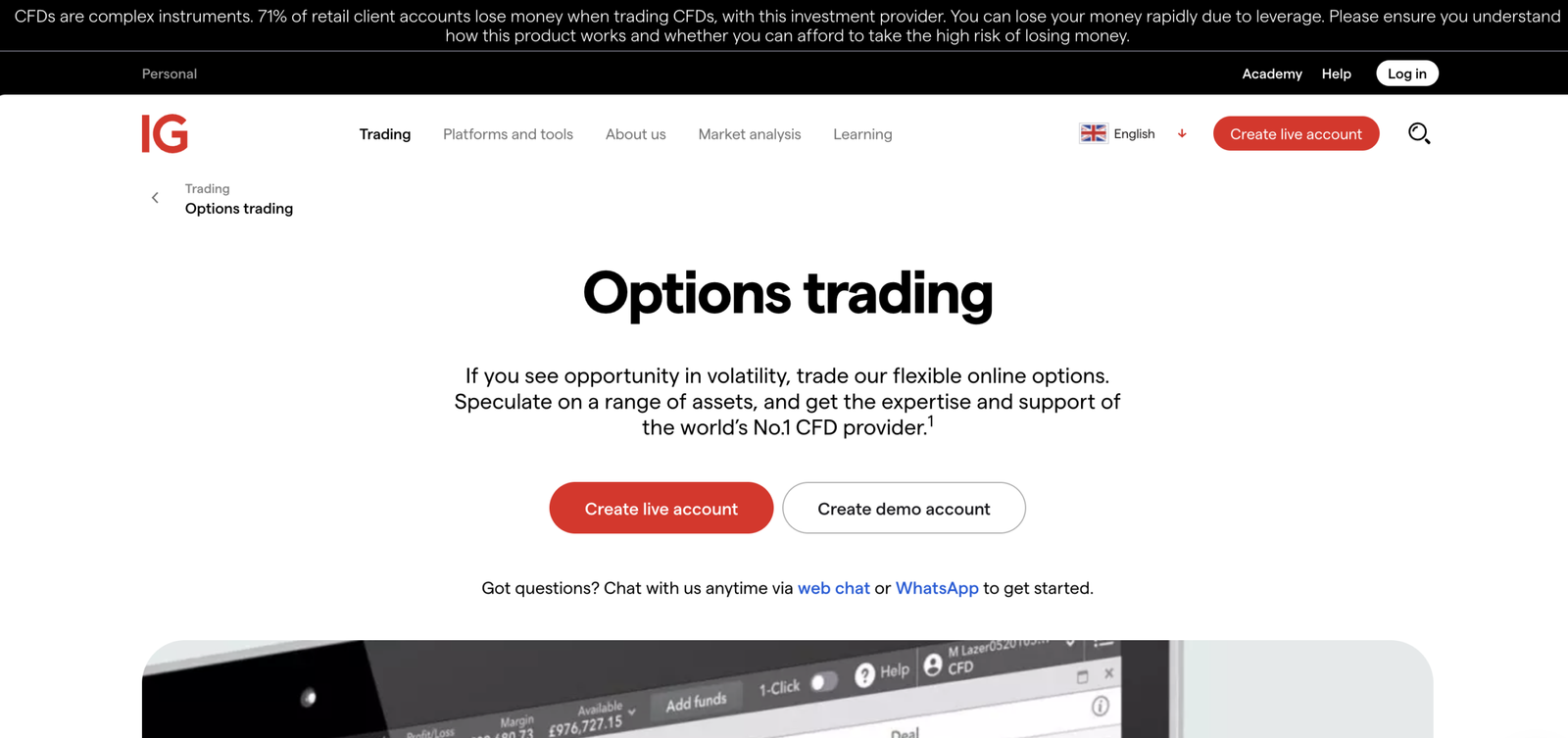
IG is a long-established UK broker (founded 1974) with deep market coverage and a strong safety profile. For listed options, UK clients typically access US options and futures via IG’s US options and futures offering, including more advanced workflow and analytics such as Analysis Mode for Greeks and scenario analysis.
Key info (at a glance)
| Item | IG Markets (UK) |
|---|---|
| FCA status | Authorised and regulated (IG Markets Ltd FRN 195355, IG Index Ltd FRN 114059). |
| FSCS | Eligible clients may be covered up to £85,000 for qualifying claims, but this does not cover trading losses. |
| Options pricing (US options) | $1.00 to open per contract, $0.00 to close (equity/ETF options; commission capped at $10 per leg), plus exchange, clearing and regulatory fees. |
| Options markets | US equity + ETF options, index options, options on futures (via US options and futures account). |
| Platforms | IG web + mobile, plus advanced tooling and integrations (varies by account or product). |
| Best for | Intermediate to advanced UK traders who want regulated access, strong tooling, and US options coverage. |
Is this options trading platform FCA-regulated?
Yes. IG Markets Ltd (FRN 195355) and IG Index Ltd (FRN 114059) are authorised and regulated by the FCA, which means IG must follow UK conduct rules and client money requirements. FSCS protection can apply to eligible claims if there is a shortfall, but it does not protect you from market losses when trading options.
How much does it cost to trade options on this platform?
For IG’s US options and futures offering, pricing is: $1.00 commission to open per contract and $0.00 to close for equity and ETF options, with commissions capped at $10 per leg on those equity or ETF option trades. You also pay exchange, clearing and regulatory fees, so the all-in cost is higher than the headline commission.
What options, markets, and contracts does this platform support?
IG’s listed options access for UK clients is primarily focused on the US: options on US stocks and ETFs, index options, and options on futures via its US options and futures account setup.
What options trading tools and analytics are available?
IG offers advanced options analytics, including Analysis Mode, which helps traders visualise potential outcomes, understand exposure, and monitor key Greeks such as delta and theta.
It is designed for traders who want scenario-style modelling and probability-based views rather than a basic “buy call or put” interface. IG also publishes educational explainers on the Greeks to support informed decision-making.
What risk controls and education does the platform offer?
IG provides structured learning via IG Academy, including options-specific topics such as the Greeks. As an FCA-regulated firm, IG must follow client money rules and meet regulatory standards for communications and product governance, which adds an extra layer of operational protection for UK clients.
Read the complete IG review here.
Pros and cons
| Pros | Cons |
|---|---|
| FCA-regulated UK broker with a long operating history. | US options costs are in USD, and you still pay exchange, clearing, and regulatory fees. |
| Competitive US options commissions at $1 open and $0 close, capped per leg. | Options workflow can feel advanced for beginners due to Greeks, margin, and assignment risk. |
| Strong tools and learning resources, including options education and Greeks coverage. | UK retail clients cannot trade crypto derivatives under FCA rules. |
2. Spreadex – Best for tax-free spread betting
Spreadex is one of the longest-established spread betting brokers in the UK, founded in 1999 and regulated by the FCA.
While it does not focus on listed exchange-traded options in the same way as US-centric brokers, Spreadex offers options-style exposure, spread betting, and CFDs across indices, forex, commodities, shares, and selected options markets, making it popular with active UK traders.
Key info (at a glance)
| Item | Spreadex (UK) |
|---|---|
| FCA status | Authorised and regulated by the FCA (Spreadex Ltd). |
| FSCS | Client money is held in segregated accounts. FSCS does not protect trading losses from spread betting or CFDs. |
| Options pricing | Costs are built into the spread. No separate commission on spread bets. Overnight financing applies if positions are held. |
| Options markets | Selected options and options-style markets via spread betting and CFDs on indices, forex, commodities, and shares. |
| Platforms | Proprietary web platform and mobile apps for iOS and Android. |
| Best for | Active UK traders who want tax-free spread betting, fast execution, and a simple, reliable platform. |
Is this options trading platform FCA-regulated?
Yes. Spreadex is authorised and regulated by the Financial Conduct Authority, meaning it must meet strict UK standards on conduct, capital adequacy, and client money segregation.
How much does it cost to trade options on this platform?
Spreadex uses a spread-based pricing model, so there is no explicit commission on most spread betting trades. Costs are reflected in the quoted spread, which is competitive on major indices and forex pairs. Overnight financing charges apply if positions remain open beyond the trading day, and costs vary by market and volatility.
What options, markets, and contracts does this platform support?
Spreadex provides access to options and options-style exposure primarily through spread betting and CFDs, rather than a full suite of exchange-traded listed options. Traders can take positions on indices, forex, commodities, shares, ETFs, and selected options markets, which suit short-term and intraday strategies rather than complex multi-leg listed options trading.
What options trading tools and analytics are available?
Spreadex focuses on speed and clarity rather than complexity. Traders get advanced charting, multiple technical indicators, drawing tools, price alerts, and watchlists. Trades can be placed directly from charts, making it efficient for intraday decision-making.
What risk controls and education does the platform offer?
Risk management tools include guaranteed stop losses on selected markets, standard stop and limit orders, and clear margin requirements. Spreadex provides market commentary, news, and trading guides, but its education offering is lighter than some larger brokers. It is best suited to traders who already understand leveraged trading risks.
Read the complete Spreadex review here.
Pros and cons
| Pros | Cons |
|---|---|
| FCA-regulated UK broker with a long operating history. | No full suite of exchange-traded listed options or advanced Greeks analysis. |
| Tax-free spread betting for UK residents. | Educational content is limited for complete beginners. |
| Tight spreads, fast execution, and strong mobile apps. | No MetaTrader, automation, or copy trading features. |
3. CMC Markets – Best for advanced charting and execution
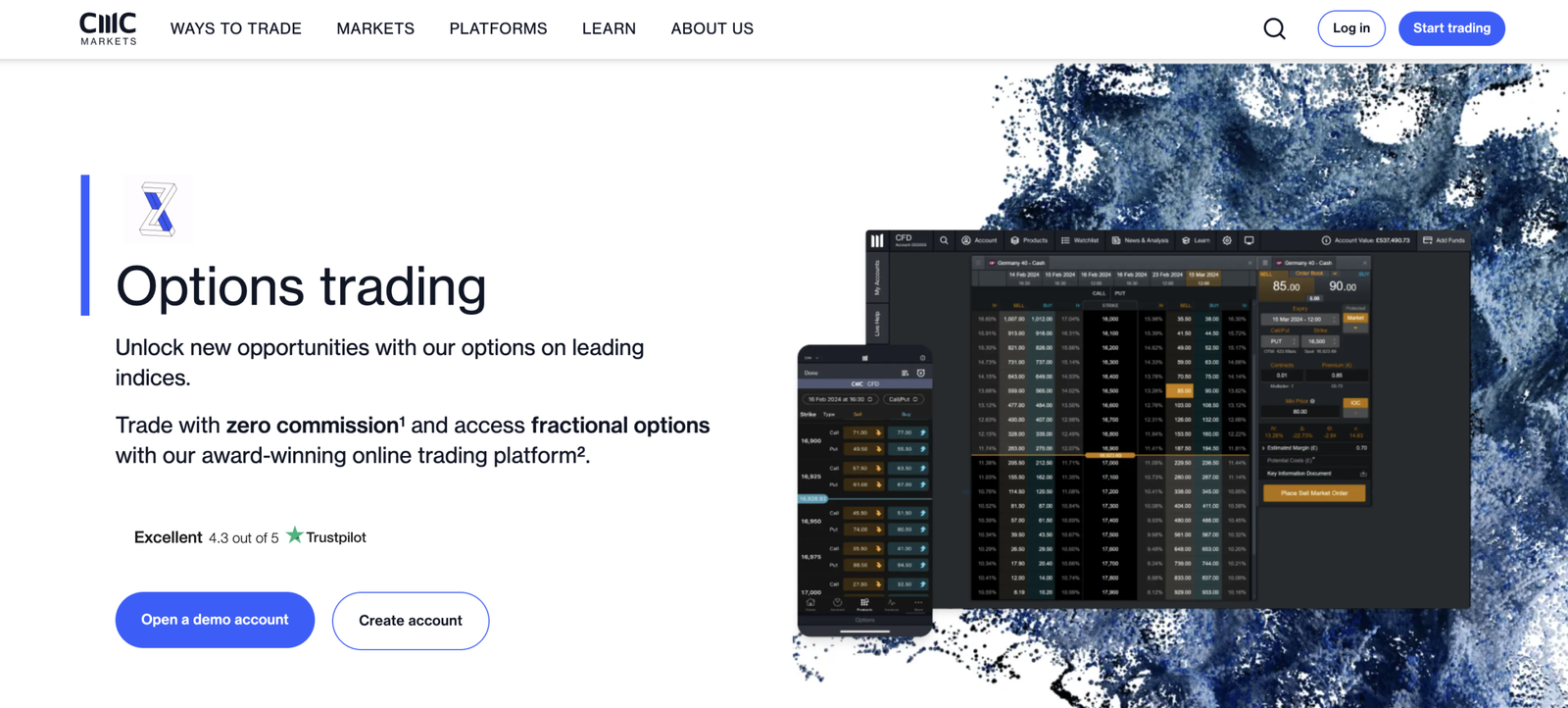
CMC Markets is a well-established UK trading platform founded in 1989, offering CFDs and spread betting with highly competitive pricing and one of the most advanced proprietary trading platforms in the UK. It is particularly known for execution quality, deep market coverage, and professional-grade tools suited to active and experienced traders.
Key info (at a glance)
| Item | CMC Markets (UK) |
|---|---|
| FCA status | Authorised and regulated by the FCA. |
| FSCS | Eligible UK clients protected up to £85,000 if the firm fails. Trading losses are not covered. |
| Options pricing | Options exposure available via CFDs and spread betting. Costs are built into the spread. Overnight financing applies. |
| Options markets | Options-style exposure on indices, shares, forex, and commodities via CFDs and spread betting. |
| Platforms | Next Generation proprietary platform, MT4, TradingView integration, iOS and Android apps. |
| Best for | Intermediate to advanced UK traders who want tight spreads, fast execution, and advanced analysis tools. |
Is this options trading platform FCA-regulated?
Yes. CMC Markets is authorised and regulated by the Financial Conduct Authority in the UK. Client funds are held in segregated accounts, and eligible retail clients are protected by the FSCS up to £85,000 if CMC were to fail. This protection does not cover losses from trading CFDs or spread betting.
How much does it cost to trade options on this platform?
CMC Markets offers options-style trading primarily through CFDs and spread betting, with costs built into the spread rather than charged as a separate commission. FX spreads start from around 0.7 pips on major pairs, and index spreads are highly competitive. Overnight financing charges apply to leveraged positions held beyond the trading day.
What options, markets, and contracts does this platform support?
CMC Markets does not offer a full suite of exchange-traded listed options. Instead, UK traders access options-style exposure via CFDs and spread betting on global indices, shares, forex pairs, commodities, and selected crypto CFDs for eligible clients. This structure suits short-term and tactical trading rather than complex multi-leg listed options strategies.
What options trading tools and analytics are available?
CMC Markets’ Next Generation platform is one of the most advanced in the UK. Traders get access to over 80 technical indicators, multi-chart layouts, advanced order types, client sentiment tools, price projection features, and highly customisable workspaces. These tools support detailed technical analysis and precise trade execution.
What risk controls and education does the platform offer?
CMC Markets provides strong built-in risk controls, including guaranteed stop-loss orders, negative balance protection for retail clients, and detailed margin transparency. Educational resources include a demo trading account, structured learning content, webinars, and in-house market analysis, making it suitable for traders who want to improve their skills over time.
Read the complete CMC Markets review here.
Pros and cons
| Pros | Cons |
|---|---|
| FCA-regulated and LSE-listed with a long UK operating history. | No full exchange-traded listed options offering. |
| Tight spreads, fast execution, and deep liquidity. | Platform can feel complex for beginners. |
| One of the most advanced proprietary platforms in the UK. | CFDs and spread betting are high-risk leveraged products. |
4. Capital.com – Best for beginners
Capital.com is an FCA-regulated trading platform focused on low-cost CFD and spread betting trading across forex, indices, shares, commodities and ETFs. It is best known in the UK for its beginner-friendly design, zero-commission pricing, and strong in-app education, making it popular with newer traders and mobile-first users.
Key info (at a glance)
| Item | Capital.com (UK) |
|---|---|
| FCA status | Authorised and regulated by the FCA. |
| FSCS | Eligible UK client funds protected up to £85,000 if the firm fails. Trading losses are not covered. |
| Options pricing | CFDs only. 0 percent commission, costs built into the spread. Overnight financing applies on leveraged positions. |
| Options markets | Options-style exposure via CFDs on forex, indices, shares, commodities and ETFs. No listed exchange-traded options. |
| Platforms | Capital.com web platform, iOS and Android apps, TradingView integration, MT4 support. |
| Best for | Beginner and intermediate UK traders who want low fees, simple tools, and mobile-first CFD trading. |
Is this options trading platform FCA-regulated?
Yes. Capital.com is authorised and regulated by the Financial Conduct Authority in the UK. Client funds are held in segregated accounts, and eligible UK clients receive FSCS protection up to £85,000 if the firm becomes insolvent. This protection does not cover losses from CFD or spread betting trading.
How much does it cost to trade options on this platform?
Capital.com offers 0 percent commission trading on all CFDs, with costs built into the spread. There are no deposit or withdrawal fees. Overnight financing charges apply to leveraged positions held beyond the trading day, and a small currency conversion markup may apply when trading non-GBP instruments.
What options, markets, and contracts does this platform support?
Capital.com does not offer exchange-traded listed options. UK traders access options-style exposure through CFDs and spread betting on over 3,000 markets, including major forex pairs, global indices, commodities, shares and ETFs. Crypto CFDs are not available to UK retail clients due to FCA restrictions.
What options trading tools and analytics are available?
Capital.com provides a clean and intuitive trading interface with solid technical analysis tools, price alerts, watchlists and performance analytics. Traders can connect accounts to TradingView for advanced charting with 100+ indicators or use MT4 for algorithmic strategies. Built-in analytics help users track win rates, risk exposure and behavioural patterns.
What risk controls and education does the platform offer?
Capital.com includes negative balance protection for retail clients, clear margin requirements, and standard stop and limit orders. Education is a key strength, with the Investmate app offering structured lessons, tutorials and quizzes in plain English. A free demo account allows users to practise without risking real capital.
Read the complete Capital.com review here.
Pros and cons
| Pros | Cons |
|---|---|
| FCA-regulated with FSCS protection for eligible UK clients. | CFDs only, no real stocks or ETFs. |
| 0 percent commission and no deposit or withdrawal fees. | Overnight fees apply to leveraged positions. |
| Very beginner-friendly platform with strong education tools. | No ISA, SIPP, or long-term investing accounts. |
5. Interactive Brokers – Best for low fees and global options access
Interactive Brokers is a global trading platform widely used by professional and advanced traders for its extremely low fees, deep international market access, and institutional-grade trading tools. In the UK, it is FCA regulated and best suited to confident, self-directed traders rather than beginners.
Key info (at a glance)
| Item | Interactive Brokers (UK) |
|---|---|
| FCA status | Authorised and regulated by the FCA (Interactive Brokers (U.K.) Limited). |
| FSCS | Eligible UK client assets protected up to £85,000 if the firm fails. Trading losses are not covered. |
| Options pricing | Options from around £0.15 per contract, exchange-based pricing, no spread markups. |
| Options markets | Equity, index and ETF options across major US, UK, European and Asian exchanges. |
| Platforms | Trader Workstation (TWS), Client Portal (web), IBKR Mobile, IBKR GlobalTrader, API access. |
| Best for | Advanced and active UK traders who want very low fees, global access, and professional tools. |
Is this options trading platform FCA regulated ?
Yes. Interactive Brokers operates in the UK through Interactive Brokers (U.K.) Limited, which is authorised and regulated by the Financial Conduct Authority. Client funds are held in segregated accounts, and eligible UK clients are covered by the FSCS up to £85,000 if the firm were to fail. This protection does not cover market losses or losses from leveraged trading.
How much does it cost to trade options on this platform?
Interactive Brokers is among the cheapest options brokers available to UK traders. Options commissions typically start from around £0.15 per contract, with pricing based on exchange fees rather than widened spreads. There are no inactivity fees, and FX conversion costs are exceptionally low at around 0.03%, which materially reduces total trading costs for international options trading.
What options, markets, and contracts does this platform support?
Interactive Brokers offers one of the broadest options selections available to UK traders, including equity, ETF and index options across the US, UK, Europe and Asia. Traders can access options on major stocks, indices and ETFs on exchanges such as the CBOE, NYSE, Nasdaq, Eurex and LSE, making it suitable for complex, multi-market strategies.
What options trading tools and analytics are available?
Interactive Brokers provides industry-leading options tools through Trader Workstation. These include options chains, strategy builders, probability and Greeks analysis, volatility surfaces, risk graphs, and advanced order types. Portfolio analytics and scenario modelling allow traders to assess exposure across positions, making the platform particularly strong for serious options traders.
What risk controls and education does the platform offer?
Risk controls include detailed margin reporting, portfolio stress testing, real-time risk metrics, and configurable alerts. Retail clients receive negative balance protection under FCA rules. Education is available via IBKR Campus, webinars, and documentation, but the learning style assumes prior knowledge and is less beginner-friendly than UK app-first platforms.
Read the complete Interactive Brokers review here.
Pros and cons
| Pros | Cons |
|---|---|
| Extremely low options, FX and trading fees. | Platform is complex and overwhelming for beginners. |
| Access to global options markets across 90+ exchanges. | Limited hand-holding and simpler guided investing tools. |
| Professional-grade analytics, Greeks and strategy tools. | ISA carries a £3 monthly fee if inactive. |
What should you look for in an options trading platform?
The best options trading brokers in the UK combine reliable execution, broad contract access, transparent fees, and strong risk tools. Because options are time-sensitive instruments, small differences in pricing, latency, or platform stability can have a meaningful impact on results.
Platform reliability and execution quality
Fast and reliable execution is critical for options trading. Delays, slippage, or outages can materially affect fills and pricing, especially around US market opens, earnings, or data releases. Look for platforms with millisecond-level execution, stable infrastructure, and clear order routing.
Platforms such as Interactive Brokers are widely used by active traders because they prioritise execution quality and publish detailed performance metrics.
Market access and contract availability
Not all UK platforms offer true exchange-traded options. Many only provide options-style exposure via CFDs or spread betting. You should check for:
- Access to US-listed options and major exchanges.
- Weekly and short-dated expiries for flexible strategies.
- A wide range of strike prices and good liquidity.
Costs and fees
Options costs add up quickly. Focus on per-contract commissions, FX conversion fees, and exchange charges, not just headline pricing. For active traders, lower per-contract costs and cheap FX can make a significant difference over time.
Risk tools and regulation
A good platform should provide Greeks, payoff diagrams, and margin visibility to help manage risk. Always use an FCA-authorised provider
Do you need advanced strategy tools or just the basics?
The tools you need depend entirely on how complex your options strategies are and your experience level.
Advanced traders benefit from detailed analytics and custom strategy builders, while beginners are usually better served by simpler platforms with guidance, demos, and clear risk information.
Choosing the wrong level of complexity can either limit your strategy or increase mistakes.
Tools for advanced options strategies
Advanced options traders need deep analytics to quantify risk and probability before placing trades. Platforms aimed at experienced users typically support multi-leg strategies and provide real-time insights into how positions behave as price, volatility, and time change.
Key advanced tools include:
- Greeks analysis such as delta, gamma, theta, and vega to measure sensitivity.
- Volatility tools, including implied volatility and volatility skew.
- Probability analysis showing the likelihood of profit at expiry.
- Multi-leg strategy builders for spreads, straddles, iron condors, and butterflies.
- Scenario and stress testing to model adverse market moves.
Platforms like Interactive Brokers and IG are built for this level of trading. They support US-listed options, complex order types, and professional-grade analytics, but they also come with a steeper learning curve.
Simpler tools for beginners
Beginner-friendly platforms focus on clarity, guidance, and risk awareness rather than complexity. The goal is to help new traders understand how options behave without overwhelming them with data.
Typical beginner-focused features include:
- Clean, simplified interfaces with fewer inputs.
- Predefined strategies or guided trade setups.
- Clear payoff and max-loss displays instead of raw Greeks.
- Demo or paper trading accounts using virtual funds.
- Educational prompts and tutorials explaining terms in plain English.
Platforms such as Capital.com and spread betting providers like Spreadex are often easier to use, but they typically offer options-style exposure via CFDs or spread betting rather than full exchange-traded options.
Quick comparison: advanced vs basic tools
| Trader type | Tools needed | Typical platform fit |
|---|---|---|
| Beginner | Demo account, simple layouts, guided trades | Capital.com, Spreadex |
| Intermediate | Basic Greeks, payoff diagrams, strategy templates | IG |
| Advanced | Full Greeks, volatility analysis, multi-leg builders | Interactive Brokers |
Should you choose CFD options or listed options contracts?
UK traders should choose between CFD options and listed options based on experience, strategy complexity, and cost sensitivity.
CFD options are simpler and quicker to access, while listed options offer deeper liquidity, tighter pricing, and far greater strategic flexibility. Understanding the structural differences is essential before choosing a platform.
Differences between CFDs and listed options
CFD options are over-the-counter derivatives offered directly by CFD brokers, while listed options are exchange-traded contracts listed on regulated venues such as the CBOE or Eurex.
This distinction affects transparency, pricing, and how strategies can be built.
| Feature | CFD options | Listed options |
|---|---|---|
| Where they trade | Broker-issued (OTC) | Regulated exchanges |
| Pricing transparency | Broker-set prices | Market-driven bid and ask |
| Liquidity | Depends on the broker | Exchange liquidity |
| Multi-leg strategies | Limited or manual | Fully supported |
| Greeks visibility | Often simplified | Full Greeks available |
| Assignment risk | Usually cash-settled | Physical or cash settlement |
| Typical UK platforms | Spreadex, CMC Markets, Capital.com | Interactive Brokers, IG |
CFD options are often easier to use but lack the depth, strike range, and expiry choice available with listed contracts. Listed options allow precise strategy construction using multiple legs, expiries, and strikes, which is not always possible with CFDs.
Pricing and cost implications
CFD option costs are built into the spread, which can widen significantly during volatile periods. This makes true cost comparison difficult. Listed options use transparent per-contract commissions plus exchange fees, which is generally more cost-effective for active traders.
Typical examples:
- CFD options: No commission, but wider spreads and overnight financing.
- Listed options: ~£0.15 to £1.00 per contract, plus small exchange fees.
- FX costs: Can exceed 0.5% on CFD platforms versus ~0.03% on professional listed-options platforms.
Over time, these differences can materially affect performance, especially for frequent traders.
Which option type suits different traders
CFD options tend to suit short-term or speculative traders, while listed options are better for strategy-driven and long-term options trading.
| Trader profile | Better option type | Why |
|---|---|---|
| Beginner | CFD options | Simpler interface and lower learning curve |
| Day trader | CFD options | Fast execution and short-term focus |
| Strategy trader | Listed options | Full multi-leg and volatility strategies |
| Earnings or volatility trader | Listed options | Better pricing and strike flexibility |
| Cost-sensitive active trader | Listed options | Lower total trading costs |
How we test options brokers
UK options brokers are reviewed using a consistent, hands on testing process focused on regulation, options pricing, platform usability, trading tools, and overall reliability. Each broker is scored from 1 to 5 across key categories based on real account use and live options trading where available.
Assessments prioritise FCA regulation, transparent options fees and spreads, margin requirements, platform stability, and ease of placing and managing options trades. Testing covers order execution, options chains, risk tools such as Greeks and expiry management, as well as deposits, withdrawals, and customer support.
All reviews are independent and evidence based, designed to help UK traders choose a safe and reliable options broker based on real performance rather than marketing claims.
For a full breakdown of our review process, visit our detailed guide on How We Test.
Conclusion: Choosing the best options trading platform in the UK
There is no single best options trading platform for every UK trader. The right choice depends on your experience, strategy complexity, and whether you need listed options or simpler derivatives.
For serious options traders who want true exchange-traded contracts, the lowest fees, and advanced analytics, Interactive Brokers is the strongest overall pick. It offers global options access, professional-grade tools, and industry-leading pricing, but requires confidence and experience.
For traders who prefer a UK-based platform with strong regulation, support, and a broad product mix, IG stands out as the best all-rounder. It balances listed options access with CFDs and spread betting in one account.
If your focus is technical trading and execution quality, CMC Markets excels, while Capital.com is better suited to beginners who want low costs, a clean interface, and strong education. Spreadex remains a solid choice for tax-free spread betting and short-term strategies.
Is options trading legal in the UK?
Yes, options trading is legal in the UK when using an FCA-authorised platform, although FSCS protection does not cover trading losses.
What’s the best platform for beginners to trade options in the UK?
Capital.com is generally the best starting point for beginners due to its simple platform and education, though it offers CFDs rather than listed options.
What’s the difference between CFDs on options and actual options contracts?
CFDs on options are broker-issued and simpler but less transparent, while listed options are exchange-traded with better pricing and greater strategy flexibility.
Can you do option trading in the UK?
Yes, options trading is legal in the UK and offered by FCA regulated brokers, typically through listed options on major exchanges or options based CFDs. Availability and product types vary by platform, and options carry higher risk than share trading.
What is an options trading broker?
An options trading broker is a regulated platform that lets traders buy and sell options contracts, such as calls and puts, on shares, indices, or other markets. The broker provides pricing, execution, margin requirements, and risk management tools needed to trade options.
What are some good options trading strategies?
Common options trading strategies include covered calls for generating income, cash secured puts for buying shares at a lower price, and long calls or puts for directional trades with defined risk. More advanced strategies include spreads, such as bull call spreads or iron condors, which aim to limit risk while targeting specific market conditions.