

The best day trading platforms in the UK offer fast execution, low fees, and FCA-regulated safety, helping active traders manage risk while reacting quickly to market moves.
This guide compares the top UK day trading brokers on costs, tools, and usability so you can choose one that fits your strategy.
Key takeaway: What’s the best day trading platform in the UK?
The best day trading platform in the UK is eToro for most beginners, due to its simple interface, quick order execution, and strong built-in risk tools. It makes day trading more accessible and easier to learn. More advanced traders may prefer IG for professional-grade charts, XTB for low-cost forex and index trading, Pepperstone for scalping and algorithms, and Capital.com for fast, intuitive mobile trading.
Best day trading platforms: How do they compare?
| Platform | Costs & spreads | Execution speed | Tools & charting | Ease of use |
|---|---|---|---|---|
| IG | Tight spreads; no stock CFD commission | Very fast, pro-grade execution | Advanced charts, ProRealTime, MT4 | Moderate (best for experienced traders) |
| eToro | Zero-commission stocks; wider CFD spreads | Fast but not pro-level | Good charts, social features, alerts | Very easy (best for beginners) |
| XTB | Low spreads; no commissions on most CFDs | Millisecond execution | xStation 5 with 100+ indicators | Easy and intuitive |
| Pepperstone | Ultra-low Razor spreads; low commissions | Extremely fast; great for scalping | MT4, MT5, cTrader, TradingView | Easy once set up; best for pros |
| Capital.com | 0% commission; competitive spreads | 0.024s average execution | TradingView integration, 100+ indicators | Very easy and modern |
Top 5 day trading platforms – best for
- eToro – Best for beginners and simple day trading
- IG – Best for advanced charting and pro-level execution
- XTB – Best for low-cost forex and index day trading
- Pepperstone – Best for scalpers and algorithmic strategies
- Capital.com – Best for fast execution and intuitive mobile trading
UK day trading broker reviews
Below are concise reviews of the top UK day trading brokers, highlighting their key strengths, fees and tools for active traders.
1. eToro – Best for beginners and simple day trading
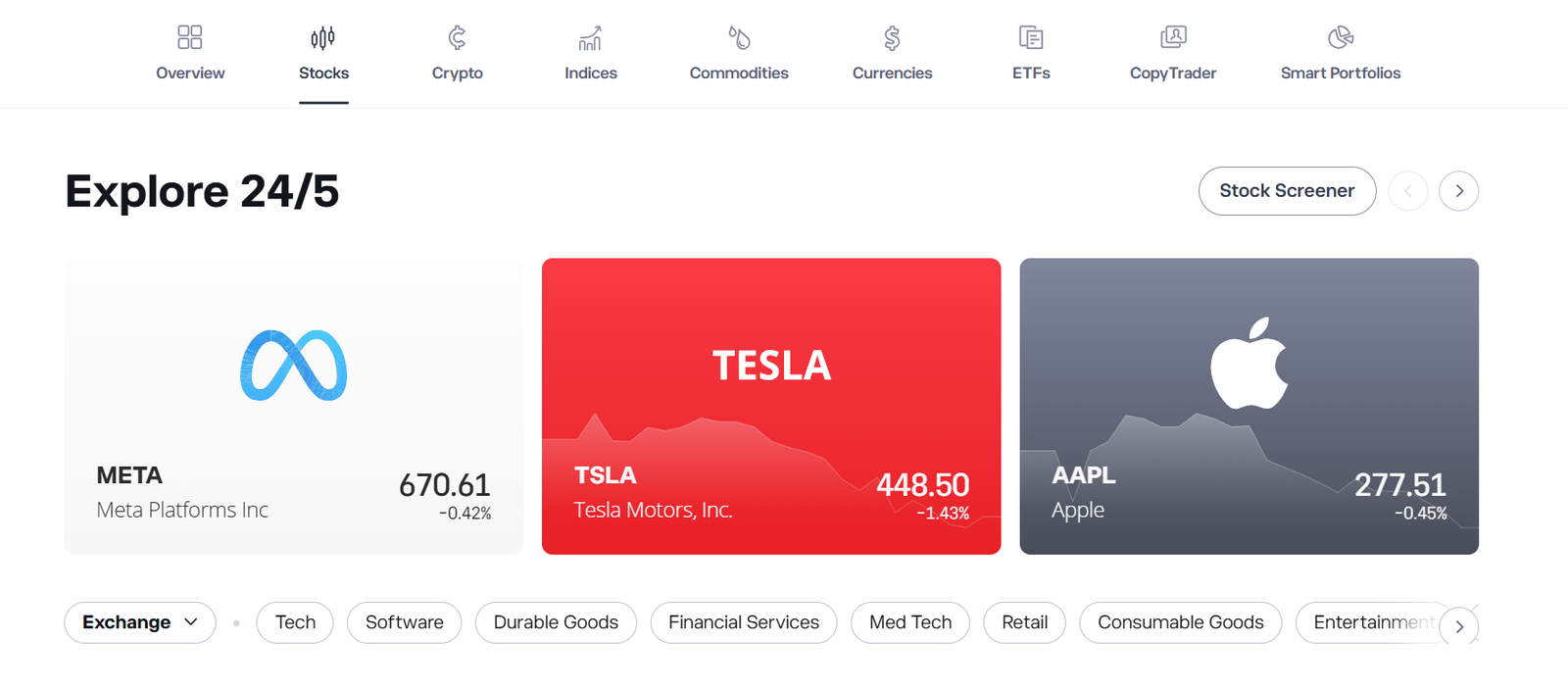
Should you use eToro for day trading?
eToro is a strong choice for beginner and intermediate day traders because of its fast order execution, simple interface, FCA regulation, and powerful risk-management tools. It’s ideal for stock and CFD day trades, but active traders should monitor spreads and conversion costs, which can be higher than those of specialist trading platforms.
Key info table
| Feature | Detail |
|---|---|
| FCA Status | FCA authorised (FRN 583263) |
| Minimum Deposit | £50 (via bank transfer) |
| Execution Speed | Instant on major assets |
| Leverage | Up to 1:30 (retail) |
| Markets | Stocks, ETFs, forex, commodities, indices |
| Platforms | Web, Mobile App, ProCharts |
| Withdrawal Fee | $5 |
| FX Conversion Fee | ~0.5% (varies) |
How fast and reliable is eToro’s execution speed?
eToro offers quick, stable execution with instant fills on major stocks, indices, and forex pairs. Its platform handles real-time price updates well, and the mobile trading app performs reliably during high-volume sessions.
However, specialist brokers like IG or Pepperstone still offer lower latency for professional-grade scalping.
What fees, spreads, and trading costs will I pay on eToro?
eToro charges £0 commission on stocks, but day traders must factor in spreads, overnight funding fees, a ~0.5% FX conversion cost, and a $5 withdrawal fee. These can influence profitability, especially for high-frequency trading.
To help assess typical costs, note that stock trades have no commission, CFD spreads vary (especially on crypto and forex), and an inactivity fee applies after 12 months.
These combined charges mean traders should monitor their position sizes and trading frequency carefully.
Does eToro offer advanced charts and technical analysis tools?
eToro includes ProCharts, which gives day traders access to multi-chart layouts, drawing tools, and essential indicators such as RSI, MACD, moving averages, and Fibonacci retracements.
This setup is strong enough for most intraday strategies and suits beginners learning technical analysis.
However, traders who rely on deep customisation, multi-timeframe backtesting, or institutional-grade tools may still prefer specialist platforms like TradingView or MT5.
Can eToro handle high-volume or rapid day trading orders?
For retail day traders, eToro performs well, supporting fast order entry, one-click trading, and responsive charting. It processes intraday orders efficiently across liquid markets like major stocks, indices, and forex.
While it can comfortably manage typical day-trade volumes, it isn’t designed for high-frequency trading or ultra-rapid scalping that requires micro-second precision.
What assets and leverage options can I trade on eToro?
eToro gives UK users access to stocks, ETFs, indices, commodities, and forex, all available for day trading through CFDs with leverage up to 1:30 under FCA rules.
Real cryptocurrencies can be bought and sold, but crypto CFDs are banned for UK retail traders, meaning short-term crypto trading must be done without leverage.
Stocks and indices offer tight spreads and fast movement for intraday strategies, while oil, gold, and major forex pairs remain popular for volatility.
The range is broad: stocks allow both zero-commission investing and CFD trading; forex offers major and minor currency pairs; indices like US30 and UK100 are commonly used for fast moves; commodities such as oil and gold attract high-volume day trading; and crypto is limited to spot assets only.
Who is eToro best for?
eToro is best for beginners and intermediate day traders who want a clean interface, fast order execution, and strong risk controls. It’s ideal for traders who value social features, CopyTrader insights, and simple web and mobile tools.
Professional scalpers needing ultra-tight spreads or deep charting may prefer IG, Pepperstone, or IBKR.
Read the complete eToro review here.
Pros & cons
Pros
- Very user-friendly for fast day trades
- FCA regulated for added trust
- Strong risk tools: stop loss, take profit, trailing stops
- Great social trading and CopyTrader features
- ProCharts provides multi-chart analysis
Cons
- Spreads can be wider than pro-level brokers
- FX conversion and withdrawal fees add up
- Limited deep institutional-grade tools
2. IG – Best for experienced day traders
Should you use IG for day trading?
IG is an excellent choice for day trading due to its tight spreads, fast execution speeds, and professional-grade tools like ProRealTime.
It’s FCA regulated, highly reliable, and ideal for traders who need precision across forex, indices, and shares.
While powerful, its interface and advanced features may feel overwhelming for beginners who prefer a simpler, app-driven experience.
Key info table
| Feature | Detail |
|---|---|
| FCA Status | FCA authorised (FRN 195355) |
| Minimum Deposit | £250 |
| Execution Speed | Very fast across major markets |
| Leverage | Up to 1:30 (retail) |
| Markets | Forex, indices, shares, commodities, real crypto |
| Platforms | Web, Mobile App, ProRealTime |
| Inactivity Fee | £12/month |
| Spread Example | From 0.6 pips (forex majors) |
How fast and reliable is IG’s execution speed?
IG is one of the fastest retail trading platforms in the UK, consistently delivering rapid execution even during major market volatility.
Its infrastructure is built for intraday traders who rely on instant fills and minimal slippage.
Whether trading forex during peak hours or indices during news releases, IG remains stable and highly responsive, making it suitable for precision-focused day traders.
What fees, spreads, and trading costs will I pay on IG?
IG offers competitive spreads starting at 0.6 pips on major forex pairs and 0.8 points on popular indices. Share trading starts at 0.1 percent, and CFD commissions are typically zero.
The main cost to watch is the £12 inactivity fee, which applies after 12 months of no trading. Compared with eToro, IG tends to offer tighter spreads but higher minimum funding requirements, making it cost-efficient for active traders.
Does IG offer advanced charts and technical analysis tools?
Yes, IG offers one of the strongest charting suites in the UK, including its proprietary platform and full ProRealTime integration for traders needing custom indicators, automated strategies, and advanced scripting.
It also provides market screeners, sentiment indicators, and a deep library of technical analysis tools. While extremely capable, the platform’s complexity may exceed what casual traders need.
Can IG handle high-volume or rapid day trading orders?
IG is designed to support high-volume, rapid intraday trading. Orders execute quickly, including during high-impact news, and the system handles large trade sizes with minimal slippage.
It’s well suited to scalpers, frequent day traders, and those running technical strategies. Although not built for high-frequency algorithmic trading, it comfortably supports fast manual and semi-automated workflows.
What assets and leverage options can I trade on IG?
IG offers a very wide range of day-trading markets: forex, indices, shares, commodities, and real crypto trading through its Uphold partnership.
With nearly 20,000 instruments, IG provides more market depth than most UK competitors. Retail leverage follows FCA rules, offering up to 1:30 on major forex pairs and lower limits on indices and commodities.
Crypto CFDs are not permitted for UK retail clients, but underlying crypto trading is available.
Who is IG best for?
IG is best for intermediate and advanced traders who need speed, charting depth, and tight spreads. It suits disciplined traders who rely on detailed analysis, multi-chart layouts, and fast execution to trade short-term moves.
Beginners may find the interface overwhelming, but seasoned traders will appreciate its power and stability.
Read the complete IG review here.
Pros & cons
Pros
- Very fast execution ideal for day trading
- Tight spreads across forex and indices
- ProRealTime integration for advanced charting
- Huge market selection including real crypto
- Strong FCA regulation and financial stability
Cons
- Learning curve for beginners
- £12 monthly inactivity fee
- Minimum £250 deposit
- No MT5 support
3. XTB – Best for low-cost, fast day trading with tight spreads
Should you use XTB for day trading?
XTB is a strong day-trading platform for UK users due to tight spreads, millisecond execution, and the advanced xStation platform.
It offers FCA regulation, a clean interface, and powerful analysis tools suited to intraday strategies. With no minimum deposit and low trading costs, XTB appeals to active traders who prioritise speed and affordability.
Key info table
| Feature | Detail |
|---|---|
| FCA Status | FCA authorised (FRN 522157) |
| Minimum Deposit | £0 |
| Execution Speed | Millisecond-level order fills |
| Leverage | Up to 1:30 (retail) |
| Markets | Forex, indices, commodities, crypto CFDs, ETFs |
| Platforms | Web, Mobile App, xStation 5 |
| Inactivity Fee | £10/month after 12 months |
| Spread Example | From 0.9 pips (EUR/USD) |
How fast and reliable is XTB’s execution speed?
XTB’s execution is extremely fast, often completing trades within milliseconds. This responsiveness is key for day traders who rely on precise entries and exits.
The xStation platform maintains high uptime, performs smoothly during volatile news events, and provides immediate chart updates, making it suitable for scalpers and intraday traders needing dependable speed.
What fees, spreads, and trading costs will I pay on XTB?
XTB offers tight spreads, low CFD costs, and transparent overnight financing, making it cost-efficient for intraday trading.
Forex spreads typically start at 0.9 pips for EUR/USD, with indices like DE40 remaining competitive as well. XTB charges no deposit or withdrawal fees, but has a £10 inactivity fee after 12 months. Its pricing is generally lower than eToro and comparable to IG for active users.
Does XTB offer advanced charts and technical analysis tools?
XTB’s xStation platform delivers over 100+ technical indicators, fast charting, pattern recognition tools, and clean multi-chart layouts.
Watchlists, real-time alerts, sentiment data, heatmaps, and economic calendars support intraday decision-making.
The platform is designed for technical traders who want speed, clarity, and access to professional-grade analysis tools without complexity.
Can XTB handle high-volume or rapid day trading orders?
Yes. XTB supports high-volume and rapid intraday trading with minimal latency. Order execution is extremely responsive, and the platform remains stable under heavy volatility.
Traders using fast-moving markets like forex or indices will find XTB suitable for managing multiple trades at once, though institutional-level HFT is not supported.
What assets and leverage options can I trade on XTB?
UK traders can access forex, indices, commodities, ETFs, and crypto CFDs, all tradeable intraday through xStation. Crypto CFD trading offers exposure to digital assets, but not real ownership.
FCA leverage rules apply, allowing up to 1:30 on major forex pairs and lower limits for indices and commodities. With a wide product range and low spreads, XTB is ideal for intraday diversification.
Who is XTB best for?
XTB is best for active day traders, scalpers, and cost-conscious intraday traders who want low spreads, fast execution, and modern charting tools.
Its user-friendly design suits intermediate traders stepping up from beginner platforms, while experienced traders benefit from fast order handling and clean analytics.
Read the complete XTB review here.
Pros & cons
Pros
- Tight spreads and low trading costs
- Millisecond-level execution
- xStation 5 offers excellent charts and 100+ indicators
- FCA regulated with segregated client funds
- £0 minimum deposit and free withdrawals
Cons
- Crypto trading limited to CFDs only
- Inactivity fee after 12 months
- No MT4 or MT5 support
- Fewer specialist markets than IG
3. Capital.com – Best for ultra-fast execution and an intuitive, beginner-friendly CFD platform
Should you use Capital.com for day trading?
Capital.com is a strong choice for day trading because of its extremely fast 0.024-second execution, clean interface, competitive spreads, and powerful TradingView-integrated charts. With more than 4,500 CFD markets and FCA regulation, it suits traders who want a fast, modern platform with helpful analytics and smart risk tools.
It’s CFDs-only, so beginners must be cautious with leverage.
Key info table
| Feature | Detail |
|---|---|
| FCA Status | FCA authorised |
| Minimum Deposit | From £10–£20 depending on method |
| Execution Speed | 0.024 seconds average |
| Leverage | Up to 1:30 (retail) |
| Markets | Shares, indices, forex, commodities, ETFs, crypto CFDs |
| Platforms | Web, Mobile App, TradingView, MT4, MT5 |
| Inactivity Fee | Applies after 12 months |
| Primary Costs | 0% commission, spread-only pricing |
How fast and reliable is Capital.com’s execution speed?
Capital.com is one of the fastest CFD brokers globally, averaging 0.024-second execution, which gives day traders immediate entry and exit during volatile moves.
The platform remains stable even during major market events, and its mobile app mirrors the same reliability, ideal for fast, reaction-based intraday strategies.
What fees, spreads, and trading costs will I pay on Capital.com?
Capital.com uses a spread-only model with 0% commissions, meaning most day-trading costs are included in the spread displayed at order entry.
Forex spreads such as EUR/USD average around 0.67 pips, and deposits and withdrawals are free. There’s an inactivity fee after 12 months, and overnight financing applies, but 1:1 stock and crypto CFDs carry no overnight charge.
Does Capital.com offer advanced charts and technical analysis tools?
Yes. Capital.com integrates TradingView, provides 100+ technical indicators, real-time alerts, drawing tools, pattern detection, watchlists, and proprietary Trading Analytics to track behaviour and performance.
The platform also includes live news from LSEG and Newsquawk, offering a strong mix of speed and insight for day traders.
Can Capital.com handle high-volume or rapid day trading orders?
Capital.com comfortably supports rapid day trading with low latency, fast order handling, and a stable execution engine. Its web and mobile platforms allow quick trade placement, one-click ordering, and real-time chart updates.
While not built for institutional HFT, it’s ideal for fast-paced intraday CFD strategies across forex, indices, and shares.
What assets and leverage options can I trade on Capital.com?
With 4,500+ CFD markets, Capital.com offers shares, indices, commodities, forex, ETFs, and one of the industry’s largest selections of 285+ crypto CFDs (not available to UK retail clients).
Retail leverage is capped at 1:30 for major forex and lower for other markets. Its broad CFD catalogue makes it highly flexible for intraday setups.
Who is Capital.com best for?
Capital.com is best for fast, cost-conscious day traders who want a simple yet powerful interface with ultra-quick execution and strong charting tools.
It suits both beginners and intermediates due to its clean platform, TradingView integration, and extensive education resources. Traders who want real asset ownership, however, will need a different broker.
Read the complete Capital.com review here.
Pros & cons
Pros
- Ultra-fast execution (0.024 seconds)
- 0% commission and competitive spreads
- TradingView, MT4, MT5, and proprietary platform
- 4,500+ CFD markets and strong crypto CFD range
- Excellent education and analytics tools
Cons
- CFDs only; no real shares or ETFs
- Crypto CFDs unavailable for UK retail clients
- Inactivity fee after 12 months
- No desktop app (web/mobile only)
4. Pepperstone – Best for scalpers and algorithmic day traders needing ultra-low spreads and fast execution
Should you use Pepperstone for day trading?
Pepperstone is one of the best brokers for day trading due to its ultra-tight spreads, raw-pricing Razor accounts, and extremely fast execution across MT4, MT5, cTrader, TradingView, and its proprietary platform.
It suits intraday traders who rely on precision, liquidity, and automation. Beginners may find the platform options complex, but active traders benefit greatly from its tools and pricing.
Key info table
| Feature | Detail |
|---|---|
| FCA Status | FCA authorised |
| Minimum Deposit | £0 |
| Execution Speed | Ultra-low latency; ideal for scalping |
| Leverage | Up to 1:30 (retail) |
| Markets | Forex, indices, commodities, ETFs, crypto CFDs |
| Platforms | MT4, MT5, cTrader, TradingView, proprietary app |
| Fee Structure | Razor (commission), Standard (spread-only) |
| Spread Example | From 0.0 pips + commission (Razor) |
How fast and reliable is Pepperstone’s execution speed?
Pepperstone excels in speed, consistently delivering low-latency execution ideal for scalpers and high-frequency intraday traders.
Its infrastructure routes orders directly to deep liquidity pools, giving reliable fills even during volatile sessions.
Across MT4, MT5, cTrader, and TradingView, orders execute with excellent stability, making Pepperstone one of the fastest platforms available for retail day traders.
What fees, spreads, and trading costs will I pay on Pepperstone?
Pepperstone offers some of the industry’s lowest day-trading costs. Razor accounts start from 0.0-pip spreads plus a small commission, while Standard accounts bundle costs into the spread.
There are no deposit, withdrawal, or inactivity fees, though overnight funding applies. Active traders can benefit from tiered rebates that reduce spread costs even further.
Does Pepperstone offer advanced charts and technical analysis tools?
Yes. Pepperstone supports advanced charting across cTrader, TradingView, MT4/MT5, and its own platform. Traders get automated strategies, smart order execution, algos, VPS support, API access, and Smart Trader Tools.
With hundreds of indicators, multiple chart types, and algorithmic capabilities, Pepperstone is ideal for traders who rely heavily on technical analysis and automation.
Can Pepperstone handle high-volume or rapid day trading orders?
Pepperstone is built for high-volume, rapid day trading through its no-dealing-desk (NDD) model and access to institutional-grade liquidity.
It supports scalping, hedging, and fast-fire intraday strategies. Its low-latency environment and deep liquidity make it especially suited to forex and index traders who require rapid entries and exits.
What assets and leverage options can I trade on Pepperstone?
Pepperstone offers over 1,300+ CFD instruments, including forex, indices, commodities, ETFs, and crypto CFDs.
UK retail clients cannot trade crypto CFDs, but can trade other CFD markets with leverage capped at 1:30 on major forex pairs. With 20+ commodities, 20+ indices, and extensive forex coverage, Pepperstone is ideal for diversified intraday exposure.
Who is Pepperstone best for?
Pepperstone is best for scalpers, algo traders, and active day traders who need ultra-low spreads, fast execution, and multiple advanced trading platforms.
Its flexibility appeals to intermediate and advanced users who trade frequently or run automated systems. Long-term investors or those looking for real shares will find better options elsewhere.
Read the complete Pepperstone review here.
Pros & cons
Pros
- Ultra-tight spreads and low-latency execution
- Excellent for scalping, algos, and high-frequency intraday trading
- Supports MT4, MT5, cTrader, TradingView, and proprietary platform
- No deposit, withdrawal, or inactivity fees
- Strong FCA regulation and deep liquidity
Cons
- CFDs only; no real assets
- Learning curve for beginners
- Crypto CFDs unavailable for UK retail clients
- Education and research not as deep as IG or CMC
What should you look for in a day trading platform?
The best day trading platforms offer fast execution, low fees, strong charting tools, FCA regulation and an intuitive mobile app. These features help UK traders place intraday orders quickly, manage risk, and analyse markets without delays.
Execution speed and reliability
Fast order execution is essential for short term trading. Look for platforms with stable servers, minimal downtime and verified execution statistics. A reliable platform reduces slippage during volatile moves.
Fees and trading costs
Low spreads and transparent commissions matter for frequent traders. Check charges for UK and global markets, plus overnight financing and currency conversion. Clear pricing supports informed decisions.
FCA regulation and safety
Choose providers authorised by the Financial Conduct Authority (FCA). Regulation ensures client fund segregation and strong operational standards. Note that CFDs are high risk and not FSCS protected.
Charting tools and technical indicators
Day traders rely on real time charts. The platform should offer drawing tools, multiple timeframes, indicators and custom layouts. Advanced charting helps spot trends and intraday setups.
Market range and order types
A good day trading broker supports UK and international stocks, forex, indices and commodities. Look for essential order types such as stop loss, take profit, trailing stops and limit orders to manage risk effectively.
Ease of use and mobile trading
Clear navigation and a fast day trading app support active trading throughout the day. Simple layouts help reduce mistakes during fast market moves.
Education and support
Strong tutorials, webinars and customer service help beginners understand tools and improve their trading process. Responsive support is valuable when markets move quickly.
Understanding day trading
What is day trading and how does it make money?
Day trading is buying and selling assets within the same day to profit from small, short-term price movements.
You make money by entering at one price and exiting at a better one, using charts, news, and volatility to time trades. Because moves are small, traders rely on speed, discipline, and tight cost control.
What skills or tools do you need to start?
Day traders need strong chart-reading skills, fast decision-making, a clear risk plan, and the ability to manage emotions under pressure.
Essential tools include real-time charts, a reliable trading platform, economic calendars, price alerts, and a fast internet connection. Beginners should practise on a demo account before trading live.
Is day trading profitable, or too risky?
Day trading can be profitable but carries high risk because markets move quickly, and losses can compound.
Most beginners lose money due to poor risk control or overtrading. It suits traders who are disciplined, follow strict rules, and understand that profits are never guaranteed.
Which markets and strategies are best for day traders?
The best markets for day trading are those with high liquidity and steady intraday movement, such as forex, indices, and large-cap stocks.
Strategies that work well include trend following, breakout trading, scalping, and momentum-based setups. A good strategy is simple, repeatable, and backed by clear risk rules.
What are the most popular markets for UK day traders?
The most popular markets for UK day traders are forex, indices, stocks and commodities because they offer high liquidity, tight spreads and regular intraday volatility. These markets provide frequent trading opportunities and are widely supported by FCA regulated platforms.
Most traded day trading markets in the UK
| Market | Why UK day traders choose it | Typical trading features |
|---|---|---|
| Forex (GBP pairs, EURUSD, USDJPY) | High liquidity and tight spreads suitable for rapid trades | 24 hour trading, leverage available, fast execution |
| Indices (FTSE 100, DAX 40, S&P 500) | Strong volatility and clear daily trends | Low costs, broad market exposure, supports technical trading |
| UK and US Stocks | Earnings releases and news driven movements create short term setups | Direct share trading or CFDs, extended hours for US stocks |
| Gold | Popular safe haven asset with strong intraday swings | Tight spreads, high volume, suitable for momentum strategies |
| Cryptocurrency (BTC, ETH) | Volatile markets and frequent price action | 24 hour trading, large movements, not FCA regulated for trading speculatively |
Which day trading strategies actually work?
Breakout strategies, trend-following setups, and momentum plays are widely used because they exploit strong intraday moves.
Scalping works for traders who prefer many small trades. Range trading can work in quieter markets. The most effective strategies use clear rules, small position sizes, and predefined stop-loss levels.
How can you manage risk while trading daily?
Use a stop loss on every trade, risk only a small percentage of your account, and avoid holding positions overnight unless planned.
Limit the number of trades per day, avoid revenge trading, and stick to liquid markets with tight spreads. A written trading plan prevents emotional mistakes.
Can you make a living through day trading?
Some traders do, but it’s uncommon and requires experience, strict discipline, and reliable capital. Profits are never consistent, and losses can be significant.
Most traders who succeed treat day trading as a structured business and manage costs, risk, and emotions carefully. It’s not a guaranteed or easy income stream.
How to open a day trading account?
- Choose an FCA regulated broker that offers fast execution and low trading costs.
- Create an account by entering basic personal details.
- Verify your identity with photo ID and proof of address.
- Deposit funds using a UK payment method such as bank transfer or debit card.
- Set up your trading platform on mobile or desktop.
- Practice with a demo account to learn tools and order types.
- Place your first live trade once you understand risks and platform features.
How much does day trading cost?
Day trading costs include spreads, commissions, overnight funding (if held too long), FX conversion fees, and any platform or withdrawal fees your broker charges.
Because day traders place frequent trades, small costs add up fast.
Low spreads and competitive pricing are essential for long-term performance.
How we test day trading platforms
Day trading platforms are assessed using a structured scoring model that rates each provider on execution speed, fees, charting tools, market access, regulation and overall user experience. Each category is scored from 1 to 5 using real accounts, live trades and verified platform data.
Our testing includes order execution checks, intraday spread comparisons, platform stability under high volume, mobile and desktop tool reviews, and funding or withdrawal speed tests. FCA oversight, transparent pricing and trader safety remain priority factors in every review.
All findings are based on hands on usage, feature verification and side by side comparisons to ensure recommendations are accurate, independent and relevant for UK day traders.
For a full breakdown of our review process, see our detailed guide on How We Test.
Conclusion
The best day trading platforms in the UK balance speed, low costs, and strong FCA-regulated protection.
For beginners, eToro stands out for its simple interface and built-in risk tools. IG is the top choice for experienced traders who want ultra-fast execution and advanced charting, while XTB offers low-cost, millisecond execution for active intraday traders.
Pepperstone is ideal for scalpers and algorithmic strategies due to raw spreads and deep liquidity. Whichever platform you choose, focus on fast execution, tight spreads, and disciplined risk management to trade safely and effectively.
FAQs
Which platform is best for day trading in the UK?
IG is the best overall for day trading due to fast execution, tight spreads, and advanced charting. eToro is the best beginner-friendly option, while XTB and Pepperstone suit low-cost and algorithmic traders.
Is it possible to make $200 a day day trading?
Possible, but not consistent or guaranteed. It requires skill, capital, and strict risk control, and most beginners lose money.
What is the 2% rule in day trade?
The 2% rule means risking no more than 2% of your account balance on a single trade to limit losses.
Is day trading legal in the UK?
Yes. Day trading is legal if you use an FCA-regulated broker and comply with UK tax rules.
What is the best day trading platform for beginners UK?
eToro is the best beginner platform due to its simple interface, social insights, and FCA regulation.
What is the best free day trading platforms in UK?
No platform is fully “free”, but eToro, XTB, Capital.com, and IG offer 0% commission with costs built into spreads.
Which is the best platform for intraday trading?
The best platform for intraday trading in the UK depends on experience level and trading style. For beginners, eToro is the best option due to its simple interface, fast execution, and built-in risk tools, while more advanced traders often prefer IG, XTB, or Pepperstone for tighter spreads, faster execution, and professional-grade charting.
References
- https://www.fca.org.uk/news/warnings/regulated-broker
- https://www.ig.com/uk/trading-need-to-knows/how-to-find-trading-platform-day-traders
- https://www.nuff.ox.ac.uk/Users/MurphyA/Active%20Traders.pdf
- https://openaccess.city.ac.uk/id/eprint/32279/
- https://research.birmingham.ac.uk/files/26134214/Chelley_Steeley_et_al_Trading_Patterns_Market_Integration_JFQA_Post_Print.pdf