

Freetrade is a UK investment app that offers commission-free trading on shares, ETFs, and investment trusts, along with optional paid plans for ISAs and additional features.
In this Freetrade review UK 2026, we outline the fees, FCA regulation, ISA options, and the key pros and cons to help you determine if it suits your investing style.
Quick verdict: How do we rate Freetrade for UK investors in 2026?
Freetrade is a strong choice for UK beginners and cost-conscious investors who want simple, commission-free investing in shares and ETFs. It is less suitable for advanced traders who need deep research tools, complex order types, or a wide range of asset classes. The platform stands out for its clean app, free ISA access, and low barriers to entry.
Overall rating: 4.2 / 5
UK ratings breakdown
| Category | Score | Summary |
|---|---|---|
| Security & Trust | 4.5/5 | FCA regulated, client money segregated, FSCS protection up to £85,000. Strong trust profile for a UK app-first broker. |
| Fees & Pricing | 4.0/5 | £0 commission on trades and no minimum investment. FX fees apply to non-GBP assets, and paid plans add fixed monthly costs. |
| Features | 3.8/5 | Good coverage of shares, ETFs, ISAs, and SIPPs. Limited research tools and no derivatives or advanced trading features. |
| Ease of Use | 4.6/5 | One of the easiest UK investing apps to use. Fast onboarding and a clean mobile-first design are ideal for beginners. |
| Customer Support | 3.5/5 | In-app chat only. Priority support on paid plans, but response times can be slow on the free tier. |
| Reputation | 4.5/5 | Well-known UK platform with a large user base and strong brand recognition after IG Group acquisition. |
Our verdict
Who should use Freetrade: Beginner investors, long-term ISA investors, and anyone who wants a low-cost, easy-to-use app for buying shares and ETFs.
Why it stands out: Commission-free trading, a free Stocks and Shares ISA, fractional shares, and one of the most beginner-friendly investing apps in the UK.
Who should look elsewhere: Active traders and experienced investors who need advanced charting, wider asset classes, or in-depth research tools may prefer platforms like Interactive Brokers or Saxo.
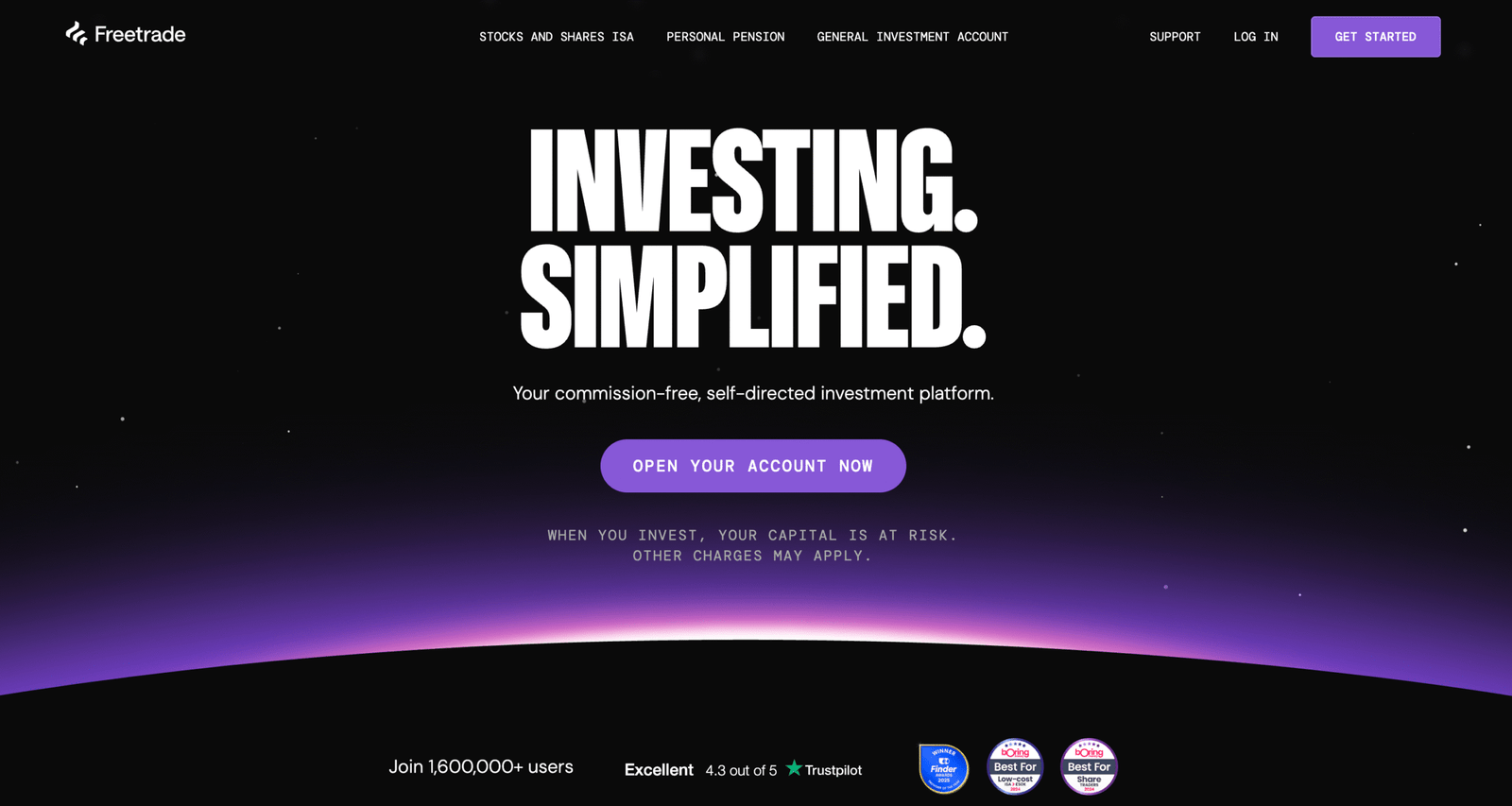
Is Freetrade good for beginners?
Yes. Freetrade is one of the most beginner-friendly investing platforms in the UK, thanks to its simple app design, commission-free trading, and very low minimum investment. New investors can buy UK and US shares and ETFs with just a few pounds, making it easy to learn without committing large sums.
Beginner friendliness
Freetrade is designed for first-time investors. The mobile-first app is clean and intuitive, account setup is fast, and there are no complex products like CFDs or leverage that could confuse or harm inexperienced users.
Learning curve
The learning curve is low. Most users can place their first trade within minutes of opening an account. However, the simplicity also means fewer advanced tools, which may limit users as they gain experience.
Education, demos, and support
Freetrade offers basic educational articles and in-app explanations, but there is no demo account and limited structured learning. Customer support is available via in-app chat, with faster responses on paid plans, but there is no phone support.
Comparison to beginner-first platforms
Compared to beginner-focused platforms like Trading 212 and InvestEngine, Freetrade is easier to use but offers less education and research. It is better suited to users who want straightforward, low-cost investing rather than guided portfolios or learning-heavy platforms.
What are the pros and cons of using Freetrade?
Freetrade offers a simple, low-cost way for UK investors to buy shares and ETFs with no dealing commissions and a free Stocks and Shares ISA. However, its simplicity comes with trade-offs, including limited research tools, FX fees on overseas shares, and fewer asset classes than full-service platforms.
Pros and cons of Freetrade
| Pros | Cons |
|---|---|
| £0 commission on UK and international share and ETF trades | FX fees apply on non-GBP assets from 0.39% to 0.99% |
| Free Stocks and Shares ISA on the Basic plan | Limited asset range. No CFDs, options, or forex |
| Beginner-friendly app with fast account setup | Basic research tools with no advanced charting |
| Fractional shares let you invest from as little as £1 | Paid plans required for SIPP and full investment access |
| FCA regulated with FSCS protection up to £85,000 | In-app support only, no phone support for UK users |
Who is Freetrade best for?
Freetrade is best suited to UK investors who want a simple, low-cost way to invest in shares and ETFs without dealing fees. It prioritises ease of use and affordability over advanced tools, which makes it ideal for some investor types but less suitable for others.
| Best For | Trader / Investor Type | Why It Suits Them |
|---|---|---|
| Beginners | First-time investors | Simple app, no commission, £1 minimum investment, and a free Stocks and Shares ISA make it easy to start without risk of high fees. |
| Active traders | Frequent traders | £0 dealing fees mean you can trade often without racking up commissions, though limited tools may frustrate advanced users. |
| Long-term investors | ISA and SIPP investors | Tax-efficient ISA and flat-fee SIPP work well for buy-and-hold investing over many years. |
| International investors | UK investors buying overseas shares | Access to US and European stocks with fractional shares, though FX fees apply on non-GBP trades. |
How regulated and trustworthy is Freetrade in the UK?
Freetrade is a regulated and trustworthy UK investment platform, authorised and supervised by the Financial Conduct Authority (FCA), which means it must meet strict rules on client protection, capital requirements, and fair treatment of customers.
FCA regulation
Freetrade operates in the UK under FCA authorisation, allowing it to provide investment services such as share dealing, ISAs, and SIPPs to UK residents. FCA oversight is a key trust signal and places Freetrade alongside established UK brokers.
FSCS protection
Client cash and eligible investments are covered by the Financial Services Compensation Scheme (FSCS) up to £85,000 per person if Freetrade were to fail. This protection applies to insolvency, not to losses caused by market movements.
Track record
Founded in 2016, Freetrade has built a large UK user base and a strong reputation as a low-cost, beginner-friendly platform. While newer than traditional brokers, its FCA regulation, FSCS protection, and IG ownership add to its overall credibility and trustworthiness.
What assets can you trade on Freetrade?
Freetrade lets UK investors trade a focused range of mainstream investments, prioritising shares and long-term investing rather than complex or high-risk products. The platform is designed for simplicity, so asset coverage is narrower than full-service brokers but sufficient for most retail investors.
Shares
Freetrade offers access to UK, US, and European stocks, including companies listed on the LSE, NYSE, NASDAQ, and major European exchanges. Fractional shares are available on US stocks, allowing you to invest from as little as £1.
ETFs
You can trade hundreds of ETFs, covering global equities, bonds, commodities, and themes such as ESG and technology. ETFs are a core part of Freetrade’s offering and are suitable for diversified, long-term investing.
Investment trusts
UK-listed investment trusts are supported, giving access to professionally managed portfolios that trade like shares.
Mutual funds
Mutual funds are available on paid plans (Standard and Plus only). This includes popular providers such as Vanguard and other UK fund managers, but the range is still smaller than traditional investment platforms.
UK government bonds
Freetrade allows trading of UK gilts and Treasury bills on paid plans, offering lower-risk options compared to equities.
What you cannot trade on Freetrade
Freetrade does not support CFDs, forex, options, futures, spread betting, or leveraged trading. Crypto exposure is limited to crypto ETNs, not direct cryptocurrency ownership.
How much does Freetrade cost to use?
Freetrade is a low-cost UK investment platform with £0 dealing fees, but total costs depend on FX charges and whether you choose a paid plan. It is cheapest for UK share investors and long-term ISA holders who trade infrequently.
Trading fees
Freetrade charges £0 commission on buying and selling shares, ETFs, and investment trusts. There are no percentage-based platform fees on portfolio value.
Spreads and commissions
There are no added spreads or per-trade commissions on standard share and ETF trades. You still pay normal market spreads set by the exchange, not by Freetrade.
FX fees
FX fees apply when trading non-GBP assets.
- Basic plan: 0.99% per trade
- Standard plan: 0.59% per trade
- Plus plan: 0.39% per trade
These fees matter most for frequent US stock investors.
Inactivity, ISA, and custody fees
There is no inactivity fee and no custody fee on any plan.
- Basic plan: £0 per month. Includes a free Stocks and Shares ISA.
- Standard plan: £5.99 per month. Adds more assets, mutual funds, and higher interest on cash.
- Plus plan: £11.99 per month. Required for SIPP access, lower FX fees, and priority support.
Key takeaway: Freetrade is excellent for commission-free UK investing, but FX fees and monthly subscriptions should be considered if you trade overseas shares or need pension access.
How good is Freetrade’s investing platform and mobile app?
Freetrade focuses on simplicity over sophistication, offering a clean web platform and one of the easiest-to-use investing apps in the UK. It is ideal for beginners and long-term investors but lacks advanced tools for active traders.
Web platform
Freetrade’s web platform mirrors the mobile experience, with a simple layout for viewing portfolios, searching investments, placing trades, and managing ISAs and SIPPs. It is intuitive and easy to navigate but offers basic charting only and limited research features.
Mobile app
The Freetrade mobile app is the platform’s strongest feature. Available on iOS and Android, it is fast, clean, and beginner-friendly, with quick search, fractional share investing, and simple order placement. However, it lacks advanced order types, price alerts, and in-depth analytics, which more active traders may miss.
How easy is it to open an account and start trading on Freetrade?
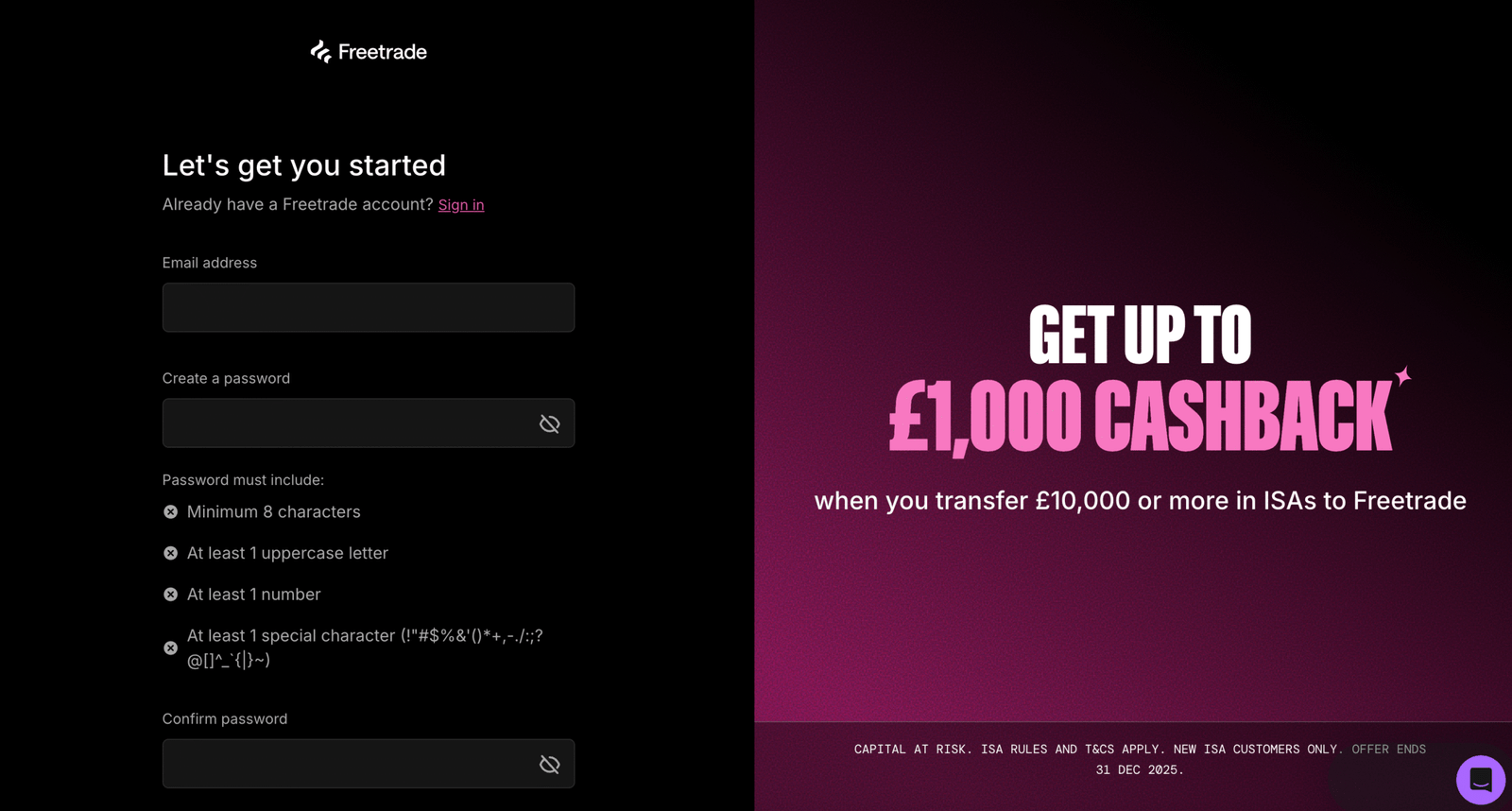
Opening a Freetrade account is quick and beginner-friendly, with a fully digital signup process that most UK users can complete in under 15 minutes. There is no minimum investment requirement, so you can start trading as soon as your account is approved and funded.
Account opening steps
- Download the Freetrade app or visit the web platform
- Enter your email and confirm your account
- Provide personal details and National Insurance number
- Complete identity verification
- Choose your account type (GIA, ISA, or Plus for SIPP)
- Fund your account via bank transfer or card and start trading
Freetrade is one of the fastest and easiest UK platforms to get started with, especially for first-time investors.
How do deposits and withdrawals work on freetrade?
| Category | Details |
|---|---|
| UK deposit methods | UK bank transfer, Faster Payments, debit card, Apple Pay, Google Pay |
| UK withdrawal methods | Bank transfer and linked digital wallets only |
| Deposit fees | £0 |
| Withdrawal fees | £0 standard. £5 for same-day withdrawal |
| Deposit speed | Instant with card and digital wallets. 1–2 working days via bank transfer |
| Withdrawal speed | 2–5 working days standard. Same day with £5 fee |
| Currency support | GBP only |
| Key restrictions | Withdrawals only to accounts in your name. Funds must settle before withdrawal. Credit cards not supported |
What account types does Freetrade offer UK users?
Freetrade offers a small, UK-focused set of account types designed for long-term, cash-based investing, rather than trading with leverage or complex structures. This keeps costs and risk lower but limits flexibility for advanced users.
Standard accounts
Freetrade provides a General Investment Account (GIA) on all plans. This is a taxable account where you can buy and sell shares, ETFs, investment trusts, and other supported assets with £0 commission. Capital gains and dividends may be taxable outside an ISA.
ISA
Freetrade offers a Stocks and Shares ISA, which is free on the Basic plan and included on paid plans. You can invest up to the UK annual ISA allowance and all gains and income are tax free.
Margin vs cash
All Freetrade accounts are cash-only. There is no margin trading, leverage, or short selling, which reduces risk and makes the platform more suitable for beginners and long-term investors.
Special accounts
- Professional accounts: Not offered. All users are treated as retail clients.
- SIPP: Available on the Plus plan only, offering a flat monthly fee pension option for long-term retirement investing.
- Junior ISA: Not available.
- Joint accounts: Not supported.
Is Freetrade right for your trading style?
Freetrade suits simple, low-cost trading styles best, particularly where commission-free investing matters more than advanced tools. It is less suitable for strategies that rely on speed, leverage, or technical analysis.
| Trading style | Suitability | Reason |
|---|---|---|
| Scalping | ★★☆☆☆ | £0 commissions help, but limited order types, no Level 2 data, and basic charting make fast, precision trading difficult. |
| Day trading | ★★★☆☆ | Frequent trading is cheap due to zero dealing fees, but the lack of advanced tools, alerts, and desktop software limits effectiveness. |
| Long-term investing | ★★★★★ | Excellent fit. Free ISA, flat-fee SIPP, fractional shares, and a simple app suit buy-and-hold investors focused on costs and tax efficiency. |
What unique features does freetrade offer?
Freetrade stands out by combining commission-free investing with a genuinely simple UK-first experience, focusing on accessibility rather than complex trading. While it lacks advanced tools, it offers several features that are still uncommon among UK investment platforms.
Rare UK features
Freetrade offers a free Stocks and Shares ISA on its Basic plan, which is still unusual among app-based brokers. It also provides a flat-fee SIPP through the Plus plan, which can work out significantly cheaper than percentage-based pension platforms for larger portfolios.
Proprietary tools
The platform’s in-house mobile app is built specifically for beginners, with themed stock discovery, clean portfolio breakdowns, and frictionless fractional share investing on US stocks. This design-led approach is proprietary to Freetrade and central to its appeal.
Competitive advantages
Freetrade’s £0 dealing fees, £1 minimum investment, and fractional shares make it easy to start investing with very little money. The combination of commission-free trading and tax-efficient accounts lowers barriers more than many traditional UK brokers.
Few UK platforms combine commission-free trading, a free ISA, and a flat-fee SIPP in one place. Add in interest paid on uninvested cash and the backing of IG Group, and Freetrade offers a rare blend of simplicity, value, and regulatory credibility for UK investors.
How good is Freetrade’s customer support?
Freetrade’s customer support is functional but not a standout, with a clear focus on digital-only service rather than live assistance. It works for routine queries but may feel limited for users who want fast or phone-based help.
| Aspect | Details |
|---|---|
| Support channels | In-app chat only |
| Phone support | Not available |
| Support hours | UK business hours |
| UK-specific support | Yes. ISAs, SIPPs, FCA rules, UK tax context |
| Response time (Basic plan) | Typically 24–48 hours |
| Response time (Plus plan) | Faster with priority support, but not instant |
| Best for | Routine queries and non-urgent support |
| Limitations | No phone or live chat. Slower responses on free plan |
Freetrade vs competitors (UK comparison)
Freetrade competes best on simplicity and fixed, low costs, while other UK platforms offer broader features or lower FX fees. The right choice depends on whether you value ease of use, asset range, or active trading tools.
- Choose Freetrade for simple, long-term investing with a free ISA and flat-fee SIPP.
- Choose Trading 212 if you want lower FX fees and more active trading features.
- Choose eToro if you want multi-asset exposure and social trading tools.
| Feature | Freetrade | Trading 212 | eToro |
|---|---|---|---|
| FCA regulated (UK) | Yes | Yes | Yes |
| FSCS protection | Yes. Up to £85,000 | Yes. Up to £85,000 | Yes. Up to £85,000 |
| Commission-free trading | Yes | Yes | Yes |
| FX fees (typical) | 0.39%–0.99% | 0.15% | 0.50% |
| Stocks & ETFs | Yes | Yes | Yes |
| Fractional shares | Yes (US stocks) | Yes | Yes |
| Stocks & Shares ISA | Yes. Free | Yes. Free | Yes |
| SIPP | Yes (Plus plan) | No | No |
| CFDs / leverage | No | Yes | Yes |
| Research & charting | Basic | Good | Good |
| Mobile app ease of use | Excellent | Very good | Good |
| Best for | Beginners, ISA & SIPP investors | Active investors, low FX fees | Social & multi-asset trading |
What are the main limitations of Freetrade?
Freetrade is deliberately simple, but that simplicity comes with trade-offs. These limitations are important to understand before choosing it as your main investing platform.
- Limited asset range. No CFDs, forex, options, futures, or spread betting.
- FX fees on overseas shares. Non-GBP trades cost 0.39% to 0.99%, which adds up for frequent US stock traders.
- Basic research and charting. Lacks advanced analysis tools, indicators, and price alerts.
- Paid plans required for full access. Mutual funds, gilts, SIPP, and lower FX fees require a monthly subscription.
- No Junior ISA or joint accounts. Limits suitability for families or shared investing.
- Customer support is app-only. No phone support and slower response times on the free plan.
- Mobile-first design. Web platform exists, but no professional desktop trading software.
Conclusion: Is Freetrade the right choice for UK investors?
Freetrade is a strong option for UK beginners and long-term investors who want commission-free trading, a free Stocks and Shares ISA, and a simple app-first experience.
It stands out for low costs, ease of use, and a flat-fee SIPP, making it especially appealing for buy-and-hold investing.
However, investors who want lower FX fees and more active trading tools may prefer Trading 212, while those seeking advanced platforms, research, and global market access are better served by Interactive Brokers.
Overall, Freetrade is best for straightforward, low-cost investing, not complex trading strategies.
FAQs
Is Freetrade legit?
Yes. Freetrade is a legitimate UK investment platform authorised and regulated by the Financial Conduct Authority (FCA).
Is Freetrade safe?
Freetrade is considered safe for UK investors because it follows FCA rules, segregates client funds, and operates under strict regulatory oversight. Investments can fall in value, but platform insolvency protections apply.
Does Freetrade have FSCS protection?
Yes. Freetrade provides FSCS protection up to £85,000 per person, covering eligible cash and investments if the firm were to fail.