

This eToro vs Robinhood in 2026 comparison explains the key differences in fees, features, assets, and regulation to help you choose the right platform.
We break down which platform is better for beginners, long-term investors, and active traders, with clear pros, cons, and risks explained upfront.
Key takeaway: Which one is better, eToro or Robinhood?
eToro is better for most UK investors, while Robinhood is only better for low-cost US stock trading. eToro wins overall due to ETFs, copy trading, and broader diversification under FCA regulation. Robinhood is best if you only want £0-commission access to US stocks and do not need ISAs, SIPPs, or wider asset choice.
eToro vs Robinhood quick comparison
| Key factor | eToro | Robinhood |
|---|---|---|
| Assets available | Stocks, ETFs, crypto, forex, indices, commodities (via CFDs) | US stocks and ADRs only |
| Fees | 0% commission on stocks & ETFs, higher crypto and FX costs | £0 commission, no FX fees (≈0.03% third-party cost) |
| Ease of use | Beginner-friendly but feature-rich | Extremely simple, app-first design |
| Tools & features | CopyTrader, Smart Portfolios, demo account | Fractional shares, 24-hour US trading |
| Mobile app | Full investing experience, slightly busier | Fast, clean, very intuitive |
| Tax efficiency (UK) | ISA available via partner only | No ISA or SIPP |
| Regulation & protection | FCA regulated, FSCS eligible up to £85,000. Crypto not FSCS protected | FCA regulated, no FSCS protection. SIPC/FDIC apply instead |
eToro – Best for beginners, commission-free investing, copy trading
eToro is a popular choice for UK beginners and hands-off investors, offering 0% commission on real stocks and ETFs, FCA oversight, and a straightforward, app-led platform. It is not ideal for frequent traders or users prioritising the lowest possible crypto fees or advanced trading functionality.
Overall rating: 4.4 / 5
- Main features: Commission-free real stocks and ETFs, CopyTrader for automatically copying other investors, Smart Portfolios for diversified themed investing, demo account with $100,000 in virtual funds, fractional share dealing, and an easy-to-use mobile-first app
- Fees: Stocks and ETFs 0% commission, crypto trading around 1% per transaction, forex spreads from approximately 1.0 pip, $5 withdrawal fee, currency conversion fees of roughly 0.75% to 1.5%
- Regulation and security: FCA authorised and regulated, FSCS protection up to £85,000 for eligible clients, segregated client money, and negative balance protection. Cryptoassets are not FSCS-protected
- What you can trade: UK, US, and international stocks, ETFs, 140+ cryptocurrencies, forex, indices, and commodities via CFDs
- Transaction types: Buy-and-hold investing in real stocks and ETFs, buying and selling real cryptoassets, CFD trading on supported markets, copy trading, and portfolio-based investing
- Who eToro is best for: Beginners getting started with investing, users seeking commission-free shares, investors interested in copy trading, and mobile-first or casual investors
Pros and cons
| Pros | Cons |
|---|---|
| 0% commission on stocks and ETFs | $5 withdrawal fee |
| FCA-regulated with FSCS protection | Higher crypto and forex fees |
| Very easy to use | Limited advanced charting |
| CopyTrader and Smart Portfolios | No SIPP, ISA via partner only |
Read the complete eToro review here.
Robinhood – Best for: beginners, low-cost US stock trading, mobile-first investing
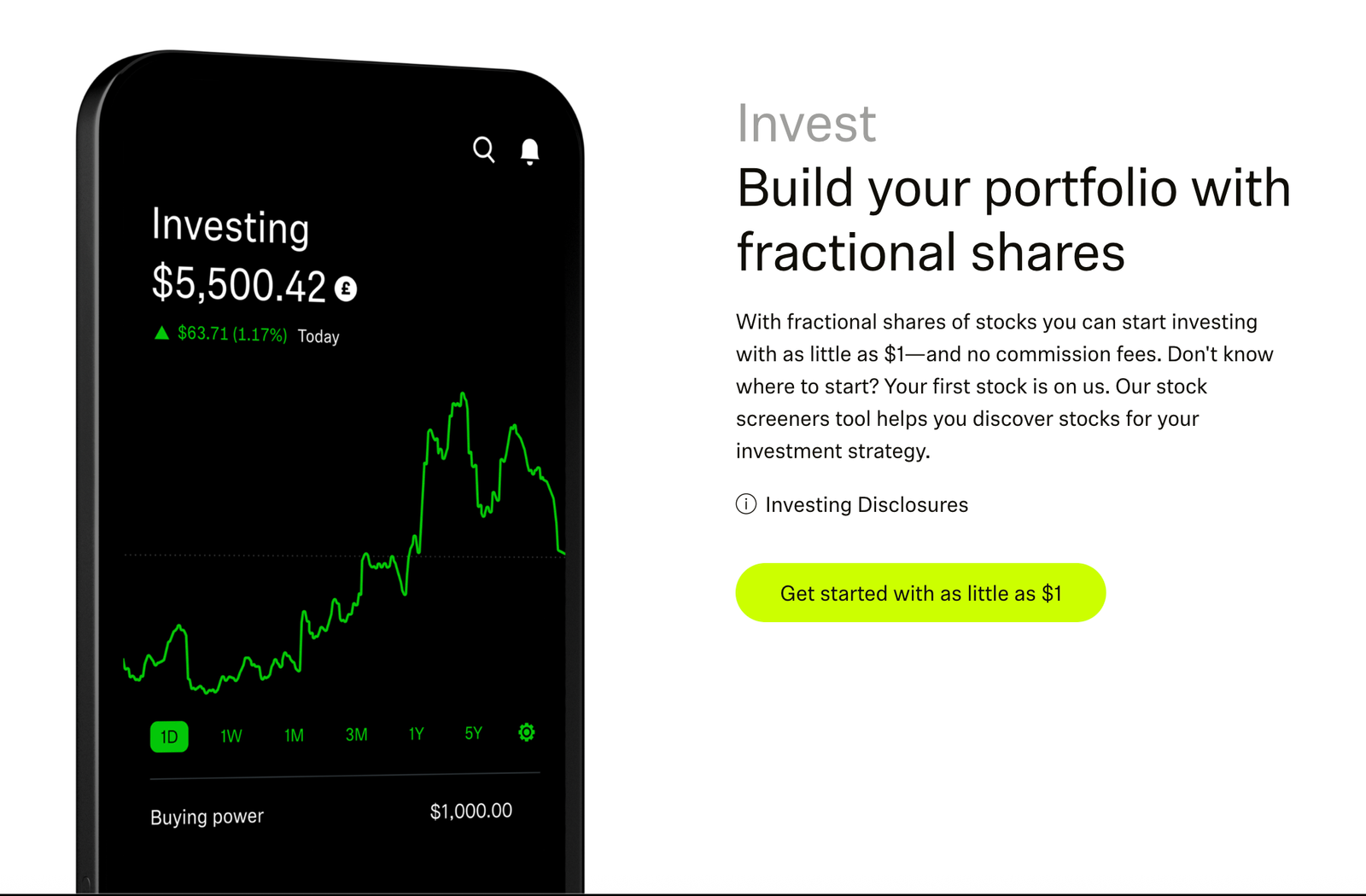
Robinhood is best suited to UK beginners and casual investors who want simple, low-cost access to US stocks through an intuitive mobile trading app. While it offers £0 commission and no FX fees, its limited asset range and lack of ISAs or SIPPs make it less suitable for long-term or tax-efficient investing.
Overall rating: 3.5 / 5
- Main features: Commission-free trading on US stocks and ADRs, fractional shares from $1, 24-hour US stock trading on selected securities, interest on uninvested cash, simple app-first design, and basic in-app educational content via Robinhood Learn
- Fees: £0 commission on buying and selling US stocks, no FX fees with a small ~0.03% third-party conversion cost, no inactivity or platform fees, no withdrawal fees, and no ISA or SIPP fees as tax wrappers are not available
- Regulation and security: FCA authorised and regulated UK entity, client assets segregated, no FSCS protection for UK investors
- What you can trade: 6,000+ US-listed stocks and ADRs only. No UK shares, ETFs, funds, bonds, crypto, forex, CFDs, or spread betting
- Transaction types: Buy and sell US stocks and fractional shares, extended and 24-hour US trading on supported securities, and limited margin trading for eligible users
- Who Robinhood is best for: UK beginners starting with US stocks, cost-focused investors making small trades, users wanting a simple mobile app, and traders focused exclusively on US markets
Pros and cons
| Pros | Cons |
|---|---|
| £0 commission on US stock trades | No Stocks and Shares ISA or SIPP |
| No FX fees on US shares | US stocks only |
| Fractional shares from $1 | No FSCS protection for UK investors |
| 24-hour US stock trading | Limited diversification options |
| Strong, beginner-friendly mobile app | Basic research and charting tools |
Read the complete Robinhood review here.
Who should use eToro or Robinhood?
eToro is better for UK beginners who want diversified, commission-free investing, while Robinhood suits cost-focused users trading US stocks only.
eToro fits investors seeking ETFs, copy trading, and FCA-regulated multi-asset exposure. Robinhood is best for casual traders prioritising zero fees and simple access to US shares without tax wrappers.
Who should use eToro?
- Beginners learning to invest with a user-friendly investing app
- Investors wanting 0% commission on stocks and ETFs
- Users interested in copy trading and ready-made portfolios
- Those needing broader diversification across markets and assets
- UK users who value FSCS eligibility and FCA regulation
Who should use Robinhood?
- UK beginners starting with US stocks only
- Traders prioritising £0 commission and no FX fees
- Users making small, frequent trades with fractional shares
- App-first investors who do not need ISAs or SIPPs
- Traders focused on short-term or learning-based investing
What assets are available on eToro vs Robinhood?
eToro offers a far broader range of assets than Robinhood, making it better for diversification, while Robinhood focuses narrowly on US stocks only.
UK users can trade multiple asset classes on eToro, including ETFs and crypto, whereas Robinhood is designed for simple, low-cost access to American shares without tax wrappers.
Asset coverage compared
| Asset type | eToro | Robinhood |
|---|---|---|
| UK & global stocks | Yes | No |
| US stocks | Yes | Yes |
| ETFs | Yes | No |
| Cryptocurrencies | Yes (140+) | No (UK) |
| Forex | Yes (via CFDs) | No |
| Indices | Yes (via CFDs) | No |
| Commodities | Yes (via CFDs) | No |
| CFDs / leveraged trading | Yes | No |
| Fractional shares | Yes | Yes (from $1) |
| Stocks & Shares ISA | Via partner | No |
| SIPP | No | No |
What this means for UK investors
- eToro suits users who want multi-asset exposure, ETFs, and optional crypto trading in one FCA-regulated platform.
- Robinhood is best for investors who only want US-listed stocks with zero commission and minimal complexity.
How do fees compare between eToro and Robinhood?
Robinhood is cheaper for trading US stocks, while eToro charges higher trading costs but offers far wider market access.
Robinhood suits cost-focused users trading only US shares with no FX fees. eToro suits investors willing to pay slightly more for ETFs, crypto, and multi-asset diversification on an FCA-regulated trading platform.
Fees comparison table
| Fee type | eToro | Robinhood |
|---|---|---|
| Stock trading commission | 0% on real stocks | £0 on US stocks |
| ETF trading commission | 0% | Not available (UK) |
| Crypto trading fees | ~1% per trade | Not available (UK) |
| Forex trading costs | Spreads from ~1.0 pip | Not available |
| FX fees | 0.75%–1.5% conversion | 0% FX fee (≈0.03% third-party cost) |
| Withdrawal fees | $5 per withdrawal | £0 |
| Inactivity / platform fees | None | None |
How do eToro and Robinhood compare on tools and platforms?
eToro offers more investing tools and social features, while Robinhood focuses on simplicity and ease of use.
eToro suits users who want copy trading, portfolio tools, and broader analysis. Robinhood is designed for beginners who value a fast, clean app for placing US stock trades with minimal complexity.
Platform and tools compared
| Feature | eToro | Robinhood |
|---|---|---|
| Mobile app | Yes, full-featured | Yes, app-first and highly intuitive |
| Web platform | Yes | Yes |
| Demo account | Yes, $100,000 virtual funds | No |
| Charting tools | Basic to intermediate | Basic |
| Technical indicators | Limited selection | Very limited |
| Copy trading | Yes (CopyTrader) | No |
| Portfolio tools | Smart Portfolios, performance tracking | Basic portfolio view |
| Research tools | Market news, asset insights | Light research, in-app education |
| Automated investing | Smart Portfolios | Not available |
| Advanced order types | Limited | Limited |
| API access | No | No |
How do the eToro and Robinhood mobile apps compare?
Both eToro and Robinhood offer strong mobile apps, but they serve different user needs. eToro’s app is more feature-rich, supporting copy trading and multi-asset investing, while Robinhood’s app prioritises speed, simplicity, and friction-free US stock trading for beginners.
How does customer support compare between eToro and Robinhood?
eToro provides broader, more structured support options, while Robinhood focuses on app-first, 24/7 assistance with fewer channels.
eToro suits users who want written guidance and UK-relevant help. Robinhood works best for users who prefer quick, in-app support linked directly to trading.
Customer support comparison
| Support feature | eToro | Robinhood |
|---|---|---|
| Support channels | Help centre, ticket system, limited live chat | In-app messaging and phone support |
| Availability | Business hours with tiered priority | 24/7 support |
| Phone support | Limited | Yes |
| Live chat | Limited availability | No |
| Email support | Ticket-based system | No dedicated email |
| Self-help resources | Extensive FAQs, guides, tutorials | Basic help articles |
| UK-specific guidance | Yes | Limited |
| Response speed | Varies by account tier | Fast for simple issues |
How does account verification compare between eToro and Robinhood?
Both eToro and Robinhood use FCA-compliant identity checks, but eToro’s process is usually faster and more predictable for UK users. Robinhood verification is simple but can take longer due to additional checks and US-linked systems, especially during periods of high demand.
Account verification comparison
| Verification feature | eToro | Robinhood |
|---|---|---|
| Account opening method | Web and mobile app | Mobile app and web |
| Minimum age | 18+ | 18+ |
| UK residency required | Yes | Yes |
| KYC requirements | ID and proof of address | ID, National Insurance number |
| Accepted ID | Passport or driving licence | Passport or driving licence |
| Proof of address | Utility bill or bank statement | Not usually required |
| Verification speed | Often same day | 1 to 3 working days typical |
| Manual review risk | Low | Moderate during busy periods |
| Demo account access | Yes, before funding | No |
| Minimum deposit | £0 | £0 |
How is tax reporting handled on eToro and Robinhood?
Neither eToro nor Robinhood handles UK taxes for you, so investors must calculate and report their own gains to HMRC. eToro provides clearer reporting tools for UK users, while Robinhood offers basic statements focused on US stocks, making manual tax tracking more important for UK investors.
Tax reporting on eToro
- Provides downloadable account statements and transaction histories
- Capital gains and dividends must be reported manually to HMRC
- ISA investing is available via a partner only, which may offer tax sheltering
- Crypto, CFD, and forex profits are taxable outside an ISA
- Cryptoassets are not FSCS protected
Tax reporting on Robinhood
- Supplies basic trade confirmations and account statements
- No UK-specific tax summaries or HMRC-ready reports
- No ISA or SIPP, so all gains may be taxable
- Profits may be subject to Capital Gains Tax and dividend tax
- US tax documents may not align neatly with UK reporting needs
How do eToro and Robinhood compare for education materials?
eToro offers broader and more structured educational content, while Robinhood focuses on lightweight, beginner-only learning. eToro suits users who want guided explanations and learning tools alongside investing. Robinhood is better for first-time investors who prefer short, simple lessons integrated into the app.
- eToro is better for users who want step-by-step learning, the ability to practise with a demo trading account, and explanations across multiple asset classes.
- Robinhood is suitable for absolute beginners who want quick, easy-to-read content focused on US stocks only.
Education materials comparison
| Education feature | eToro | Robinhood |
|---|---|---|
| Beginner guides | Yes, structured investing guides | Yes, basic articles |
| In-app learning hub | Yes | Yes (Robinhood Learn) |
| Video tutorials | Limited | No |
| Webinars / live sessions | Occasional | No |
| Market explainers | Yes, multi-asset focused | Yes, US stock focused |
| Demo account for practice | Yes | No |
| Advanced education | Limited | Very limited |
| UK-specific content | Yes | Minimal |
What does eToro offer that Robinhood doesn’t, and vice versa?
eToro offers broader asset access and investing features, while Robinhood focuses on ultra-low-cost US stock trading. eToro suits UK users who want diversification, ETFs, and social investing tools. Robinhood appeals to cost-conscious traders who only want simple, commission-free access to US shares.
What eToro offers that Robinhood doesn’t
- ETFs and multi-asset investing, including forex, indices, and commodities via CFDs
- 140+ cryptocurrencies available to UK users
- CopyTrader and Smart Portfolios for social and thematic investing
- Demo account with virtual funds to practise before investing
- Broader diversification beyond US stocks
- Optional ISA access via a partner
What Robinhood offers that eToro doesn’t
- £0 commission with no FX fees on US stock trading
- 24-hour US stock trading on selected securities
- Fractional shares from $1, ideal for small amounts
- Interest paid on uninvested cash at competitive rates
- Extremely simple, app-first experience with minimal friction
Which platform is better overall, eToro or Robinhood?
eToro is the better all-round choice for most UK investors, while Robinhood is best as a low-cost, US-stock-only trading app. eToro stands out for commission-free stocks and ETFs, copy trading, and broader diversification on an FCA-regulated platform. Robinhood excels on price, offering £0 commissions and no FX fees, but its narrow asset range and lack of ISAs limit long-term use.
Our top picks explained
- eToro is the best overall pick for beginners and casual investors who want ETFs, copy trading, and multi-asset access in one app.
- Robinhood is the best low-cost option for UK users focused purely on US stocks and simple, app-first trading.
FAQs
Why are people leaving Robinhood?
Some users leave Robinhood due to its limited asset range, lack of ISAs or SIPPs, and no FSCS protection for UK investors, making it less suitable for long-term investing.
Which is cheaper, eToro or Robinhood?
Robinhood is cheaper for US stocks with £0 commission and no FX fees, while eToro costs more but offers far broader asset access.
Does eToro offer ISAs in the UK?
eToro does not offer an ISA directly, but UK users can access an ISA via a partner platform.