

Investing in the S&P 500 from the UK is straightforward, low cost, and accessible through FCA-regulated brokers and ISA-eligible ETFs.
This guide shows you exactly how to buy S&P 500 funds, which platforms to use, and the cheapest ways to invest long term.
It also covers UK-specific tax rules and simple steps to get started confidently.
Key takeaway: How to invest in the S&P 500 from the UK?
The easiest way to invest in the S&P 500 in the UK is to buy a low cost S&P 500 ETF, such as Vanguard VUAG or iShares CSP1, using a Stocks and Shares ISA on an FCA regulated platform. This gives you instant exposure to 500 leading US companies with simple setup, low fees and tax efficient long term growth.
What is the S&P 500 and why do UK investors buy it?
The S&P 500 is the main US stock market index and tracks 500 of the largest American companies.
UK investors buy it because it offers simple diversification, strong long term performance and very low fees through ETFs and index funds.
You cannot buy the index directly, but you can buy funds that track it. The S&P 500 includes world leading companies such as Apple, Microsoft, Amazon, Nvidia and Google.
It represents around 80 percent of the US stock market, making it a reliable gauge of US economic performance.
The index is weighted by market size, so the biggest companies have the largest influence on returns. You can access the S&P 500 through ETFs, mutual funds, OEICs and US shares on UK investment platforms.
How do S&P 500 ETFs work for UK investors?
An S&P 500 ETF is a fund that aims to copy the performance of the S&P 500 index. When the index rises or falls, the ETF normally does the same.
You trade it on a stock exchange just like a share, and you can buy it easily through any FCA authorised UK trading platform or investing app.
These ETFs hold or replicate the 500 US companies inside the index. Some funds use full replication, meaning they buy all the stocks in the index.
Others use swap based or synthetic replication, using derivatives to mimic returns instead of buying shares directly.
Physical ETFs are simpler for beginners. Synthetic ETFs may track more tightly but carry counterparty risk from the swap provider.
S&P 500 ETFs differ by fees, fund size, dividend strategy and replication method. Most are domiciled in Ireland for tax efficiency.
*New to ETFs? Read our How to Invest in ETFs UK guide for a simple, step by step introduction before you start investing.
How do you invest in the S&P 500 from the UK?
You invest by opening a UK investment platform, depositing money and buying an S&P 500 ETF or index fund by searching its name or ticker.
You cannot buy the index itself. You can hold the fund in a Stocks and Shares ISA or in a General Investment Account, depending on your tax preferences.
Step by step: How to buy the S&P 500 in the UK
- 1. Choose a UK investment platform: Pick an FCA authorised broker. Popular options include eToro, XTB, AJ Bell, Vanguard, Hargreaves Lansdown and Trading 212.
- 2. Choose your account type: Most beginners use a Stocks and Shares ISA for tax free growth. A General Investment Account is fine if you already used your ISA allowance.
- 3. Deposit money: Add money using bank transfer, Faster Payments or debit card.
- 4. Search for an S&P 500 fund: Look for tickers such as VUAG, VUSA, CSP1, SPY5, IVV, SPXP, or SPXD depending on the provider.
- 5. Place a buy order: Use a market order to buy instantly or a limit order to choose your price.
- 6. Decide between accumulation (Acc) or distribution (Dist): Accumulating ETFs reinvest dividends. Distributing ETFs pay dividends into your account.
- 7. Hold long term: Most investors hold S&P 500 funds for years to benefit from compounding and reduce short term volatility.
Which S&P 500 ETFs can UK investors buy?
UK investors can choose from 22 S&P 500 ETFs listed on the London Stock Exchange.
These ETFs have very low annual fees ranging from 0.03 percent to 0.15 percent, with several popular options costing just 0.03 percent.
Below is a summary of the main providers and their funds.
iShares S&P 500 ETFs
iShares offers both physical and synthetic S&P 500 ETFs.
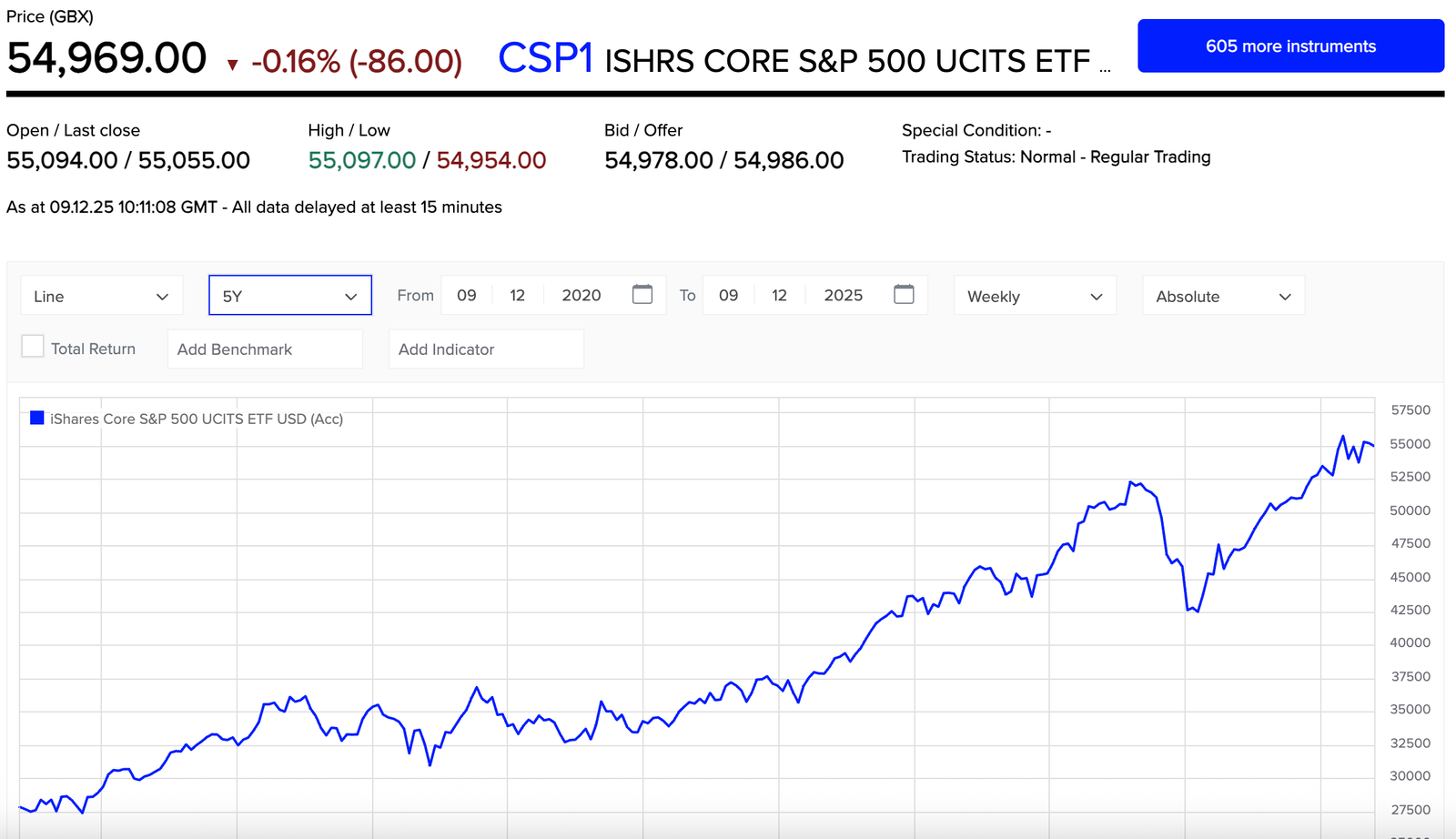
- Core product: iShares Core S&P 500 UCITS ETF (CSP1 / SXR8)
- Fee: 0.07 percent
- Replication: Physical
- Popular with beginners due to size, liquidity and long track record.
iShares also offers swap based options with slightly higher tracking accuracy.
Vanguard S&P 500 ETFs
Vanguard is known for low fees and large funds.
- Main ETFs: VUSA (distributing), VUAG (accumulating)
- Fee: 0.07 percent
- Replication: Physical
- Very large fund size, tight spreads and ideal for ISA investing.
Invesco S&P 500 ETFs
Invesco offers both accumulating and distributing versions.
- Fee: 0.05 percent
- Replication: Synthetic through unfunded swaps
- Offers slightly lower fees than Vanguard and iShares but with derivative exposure.
HSBC S&P 500 ETFs
A simple, physical option for UK investors.
- Fee: 0.09 percent
- Replication: Physical
- Available in accumulation and distributing versions.
SPDR S&P 500 ETFs
SPDR offers the cheapest S&P 500 ETFs in the UK.
- Fee: 0.03 percent
- Replication: Physical
- Very low cost but medium sized funds compared to Vanguard or iShares.
UBS and Xtrackers S&P 500 ETFs
UBS offers 0.03 percent fee ETFs with physical replication.
Xtrackers offers both physical and synthetic options, some as low as 0.04 percent.
Which S&P 500 ETF is best for UK beginners?
The best ETF depends on whether you want the lowest fee, the biggest fund or the simplest structure.
Beginners often choose Vanguard or iShares because they are physical, large and easy to research.
Good beginner options:
- VUSA or VUAG Vanguard S&P 500
- CSP1 iShares Core S&P 500
- SPY5 SPDR S&P 500 (cheapest fee)
- SPXP Invesco S&P 500 (low fee but synthetic)
If you want the absolute lowest cost, SPDR and UBS offer 0.03 percent ETFs. If you prefer an accumulating ETF that reinvests dividends automatically, VUAG is the easiest choice.
How much do S&P 500 ETFs cost in the UK?
S&P 500 ETFs have some of the lowest fees of any global funds.
- Annual charges range from 0.03 percent to 0.15 percent.
- A £10,000 investment in a 0.03 percent ETF costs £3 per year.
- A £10,000 investment in a 0.15 percent ETF costs £15 per year.
Most S&P 500 ETFs also have:
- No entry fees
- No exit fees
- Very small spreads due to high liquidity
Compared with active US funds charging 0.65 to 1.5 percent annually, the savings over time are significant.
Common mistakes UK beginners make when investing in the S&P 500
- Choosing a US-listed ETF (e.g. US-domiciled S&P 500 funds) instead of a UK/European “UCITS” version ; this can lead to complicated tax and withholding-dividend issues, plus currency and withholding-tax inefficiencies. Only buy UCITS ETFs listed on the London Stock Exchange, such as VUSA, VUAG, CSP1 or SPY5.
- Forgetting about currency risk. Because S&P 500 ETFs are denominated (and track U.S. dollar-based stocks), a strengthening pound can eat into returns when converted back to GBP. Accept normal GBP/USD movements as part of long-term investing or choose a currency-hedged version if you want to reduce exposure.
- Mixing accumulating and distributing ETFs inadvertently, leading to inconsistent dividend treatment and making it harder to predict returns or tax treatment. Decide upfront whether you prefer reinvested dividends (Acc) or payouts (Dist) and stick to one type for consistency.
- Chasing the cheapest fee only. Lower fee is good, but extremely cheap ETFs sometimes have lower liquidity (wider spreads) or less trading volume – this can cost more in practice if you trade often. Compare fee, fund size, trading volume and spreads together, not just TER, when choosing an ETF.
- Treating the S&P 500 as a “get-rich-quick” bet. It’s designed for long-term investing. Frequent trading defeats the benefit of compounding and smooths out risk reduction. Use a long-term approach, invest consistently, and avoid reacting to short-term market moves.
How do order types work when buying S&P 500 ETFs?
You can buy ETFs using two order types:
- Market orders buy at the best price available immediately.
- Limit orders let you choose a maximum price you are willing to pay.
Beginners normally choose market orders because S&P 500 ETFs are very liquid and spreads are tight.
Can you invest in the S&P 500 through an ISA?
Yes. Most S&P 500 ETFs are fully ISA eligible. When held inside a Stocks and Shares ISA:
- All gains are tax free
- All dividends are tax free
- No Capital Gains Tax
- No dividend tax
The annual ISA allowance is £20,000 per tax year.
Holding S&P 500 ETFs in an ISA is usually the most efficient option for long term investors.
What are the risks of investing in the S&P 500?
The S&P 500 is diversified, but it still carries risk.
Key risks include:
- Market risk. If US markets fall, the index falls.
- Currency risk. The S&P 500 is priced in dollars. If the pound strengthens, your investment value may drop.
- Concentration risk. The index is heavily weighted toward technology and the “Magnificent Seven”, which make up a large share of returns.
- Synthetic ETF risk. Swap based ETFs carry counterparty risk.
- Short term volatility. The index can move sharply in the short term.
Most risks are reduced when investing long term.
You can buy shares of Apple, Microsoft, Amazon, Tesla and other S&P companies individually. But this requires analysis, higher risk tolerance and paying individual transaction fees.
ETFs remove the need to pick stocks and spread your risk across all 500 companies.
Most beginners choose ETFs rather than buying US shares directly.
Do S&P 500 ETFs pay dividends?
Yes. S&P 500 companies pay dividends. If you own a distributing ETF (Dist), the dividends are paid to you. If you choose an accumulating ETF (Acc), the dividends are automatically reinvested.
Dividend yields vary by year but are typically around 1.3 to 1.5 percent annually.
Is now a good time to invest in the S&P 500?
The S&P 500 has delivered strong long term returns but has periods of volatility. Timing the market is difficult, which is why many UK investors use monthly investing plans. Long term investing, diversification and consistency usually matter more than starting date.
S&P 500 vs FTSE 100: Which is better for UK investors?
Why UK investors choose the S&P 500
- Broad diversification across 500 major US companies.
- Historically stronger long-term growth than UK markets.
- High exposure to global brands and fast-growing tech sectors.
Why UK investors choose the FTSE 100
- Higher average dividend yield – attractive for income investors.
- GBP-denominated, so no USD currency risk.
- Suits those wanting steady income aligned with UK expenses.
How to decide
- Pick the S&P 500 if you want long-term growth and global diversification.
- Pick the FTSE 100 if you prefer income stability and minimal currency risk.
- Many investors hold both: S&P 500 for growth + FTSE 100 for income and GBP balance.
*New to investing? Read our How to Invest UK guide for a simple, step by step introduction before you start investing.
FAQs
What is the S&P 500?
The S&P 500 is an index tracking 500 large US companies, including Apple, Microsoft and Amazon.
Can I invest in the S&P 500 from the UK?
Yes. You can invest using S&P 500 ETFs or index funds on any FCA authorised UK platform.
Which S&P 500 ETF is best?
Popular choices include Vanguard VUSA, Vanguard VUAG, iShares CSP1 and SPDR SPY5.
Does the S&P 500 pay dividends?
The index itself does not, but the companies inside it do. ETFs pass these to investors. You get paid dividends if you choose a distributing ETF (Dist).
Is the S&P 500 good for beginners?
Yes. It is diversified, low cost and simple to invest in via ETFs.
How to invest in the S&P 500 for beginners in the UK?
Beginners can invest by opening an FCA authorised broker, choosing a Stocks and Shares ISA or General Investment Account, and buying an S&P 500 ETF such as VUSA, VUAG, CSP1 or SPY5.
Can UK citizens invest in the S&P 500?
Yes. UK investors can buy S&P 500 ETFs and index funds on any mainstream investment platform. You cannot buy the index directly, but you can invest in funds that track it.
What if I invested $1000 in the S&P 500 10 years ago?
Historically, the S&P 500 has grown significantly over the past decade. A $1000 investment would have grown in value, although past returns do not guarantee future results.
What is the best S&P 500 index fund in the UK?
There is no single best fund, but popular low cost options include Vanguard VUSA and VUAG, iShares CSP1, and SPDR SPY5. The right choice depends on fees, dividend style, and whether you prefer physical or synthetic replication.
What is Vanguard S&P 500 UK?
Vanguard offers two major UK listed S&P 500 ETFs: VUSA (distributing dividends) and VUAG (accumulating). Both have a 0.07 percent annual fee and are physical replication funds.
How to invest in the S&P 500 UK via an ISA?
Open a Stocks and Shares ISA, deposit money and buy an S&P 500 ETF. ISA investing protects gains and dividends from UK tax up to the £20,000 annual allowance.
What is the cheapest way to invest in the S&P 500 UK?
The cheapest method is buying a 0.03 percent fee ETF such as SPDR SPY5 or UBS S&P 500 through a zero commission platform like Trading 212 or InvestEngine.
What is the S&P 500 UK equivalent?
The closest UK equivalent is the FTSE 100, which tracks the 100 largest companies listed in London. It is similar in concept but smaller and less diversified than the S&P 500.
References
- https://www.hsbc.co.uk/investments/what-is-the-sp-500
- https://www.charles-stanley.co.uk/insights/commentary/investing-in-the-s-p-500
- https://www.fca.org.uk/publication/policy
- https://www.spglobal.com/spdji/en/documents/research/research-why-does-the-sp-500-matter-to-the-uk.pdf
- https://www.bbc.co.uk/news/business-68035276
- https://www.marketwatch.com/investing/index/spx